
A KU-KETI Joint Research Team Has Become the World's First to Elucidate the Lifetime Deterioration Mechanism of Sulfide-Based All-Solid-State Batteries
- categorization Research
- writing date 2025.07.28
- author Communication Team
- hits 56
A KU-KETI Joint Research Team Has Become the World's First to Elucidate the Lifetime Deterioration Mechanism of Sulfide-Based All-Solid-State Batteries
The research team developed a technology for the design of large-area all-solid-state battery anodes for electric vehicles and energy storage systems.
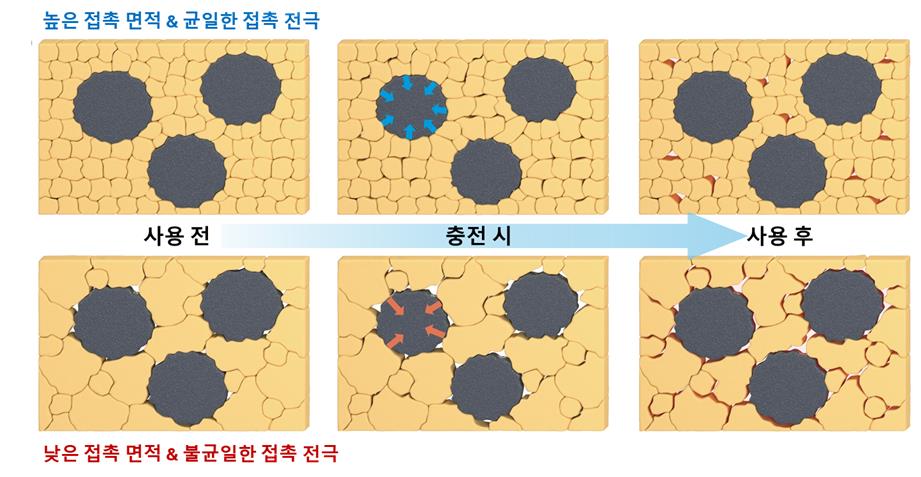
△ Schematic diagram illustrating that uniform contact between the cathode active material and the solid electrolyte can maintain a uniform interface during the charge and discharge process, but that when uneven contact occurs, cracks are generated inside the positive electrode due to local shrinkage of the electrode.
The joint research team comprised of Professor Yoo Dong-joo’s group from the Department of Mechanical Engineering at KU (President: Kim-Dong-one) and Chief Researcher Cho Woo-suk’s group from the Advanced Batteries Research Center at Korea Electronics Technology Institute (KETI) has become the world’s first to elucidate the mechanical lifetime degradation mechanism of the cathode of sulfide-based all-solid-state batteries, and based on this mechanism, they have developed a technology for the design of a large-area all-solid-state battery electrode that enables low-pressure operation.
The results of this study have been recognized for their originality and excellence and were published online on July 10 in Joule (IF=35.4, top 1% of JCR), a globally renowned journal.
*Article title: Alleviating Kinetical Delamination Induced by Localized Cathode Contact via Electrochemo-Mechanical Modeling in All-Solid-State Batteries
*DOI: 10.1016/j.joule.2025.102046
*URL: https://www.cell.com/joule/fulltext/S2542-4351(25)00227-2
All-solid-state batteries are next-generation batteries that are expected to fundamentally solve the fire and thermal runaway problems that occur in liquid electrolyte-based lithium-ion batteries by using solid-state electrolytes. All-solid-state batteries that utilize the rapid lithium ion movement of solid electrolytes have high energy density and a wide operating temperature range, and thus are considered a game changer in energy storage systems.
The performance of all-solid-state batteries is greatly affected by the physical contact between the cathode active material and the solid electrolyte. Unlike the existing liquid electrolyte that easily penetrates into the small gaps inside the electrode, the physically incomplete contact between the solid electrolyte and the cathode active material has been regarded as the cause of rapid deterioration of battery lifetime. However, the development of long-life, large-area electrode technology has been delayed because the mechanism for performance deterioration has not been clearly elucidated.
The joint research team has become the world’s first to utilize an electrochemo-mechanical model to specifically elucidate the mechanism by which the contact area and uniformity between the cathode active material and the solid electrolyte affect the battery performance. In particular, the researchers demonstrated through experiments and modeling that local shrinkage of the cathode active material during charging accelerates mechanical delamination within the electrode.
In addition, by utilizing a small and uniform particle-type solid electrolyte, the researchers improved the uniformity of the interface contact, which greatly enhanced the battery performance, and they demonstrated that low-pressure operation was possible through the proposed electrode design technology. The research team presented an electrode design and analysis method that enables the low-pressure operation required in large-area batteries used for example in electric vehicles and energy storage systems.
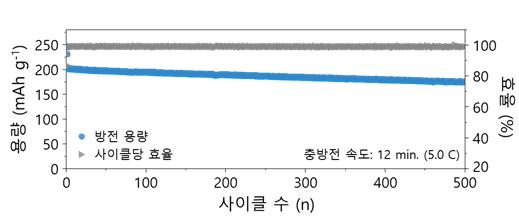
The all-solid-state battery, including the cathode developed by the research team, was more than 95% chargeable at a current density of 5 C (fully charged in 12 minutes), and 87.1% of the initial capacity was retained after 500 cycles. The team demonstrated that the performance of the battery can be dramatically improved through the design of the cathode, and the electrochemo-mechanical model proposed by the study can be utilized as an important design and analysis technology in the development of large-area all-solid-state batteries.
KU Professor Yoo Dong-joo from the Department of Mechanical Engineering said, “The significance of our study is that we approached the performance of all-solid-state batteries in a new way in relation to everything from materials to the multi-scale mechanical behavior of electrodes and cells, and we have systematically demonstrated the importance of physical contact between solid electrolytes and cathode active materials through battery performance and modeling technology. We expect that our results could be directly applied to the design of high-performance, long-life all-solid-state battery electrodes using high-energy cathodes.”
This study was supported by the National Research Foundation of Korea, the Korea Planning & Evaluation Institute of Industrial Technology, and the National Research Council of Science & Technology.
[Figure 1]

△ KU Professor Yoo Dong-joo from the Department of Mechanical Engineering (corresponding author), Chief Researcher Cho Woo-suk from the Advanced Batteries Research Center at Korea Electronics Technology Institute (KETI) (co-corresponding author), and Senior Researcher Choi Seung-ho from the Advanced Batteries Research Center at KETI (co-corresponding author).
[Figure 2]