- writing date 2026.10.13
- author Communication Team
- hits 1
Biosystem and Biomedical Science
Professor Heenam Kim
and the Human–Microbe Interac-tion Laboratory
: Exploring the Gut Microbiome
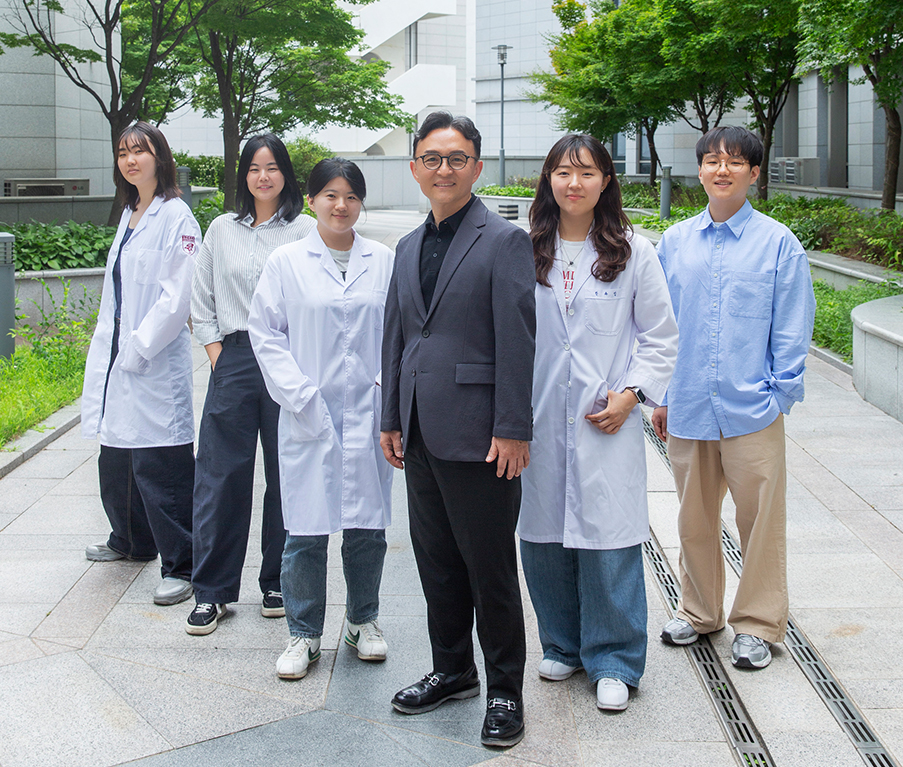
The human body does not belong to humans alone. Countless microorganisms live together with us in our intestines, playing an important role in immunity, metabolism, inflammatory re-sponses, and the development of disease. Professor Kim Heenam of the School of Biosystem and Biomedical Science is a microbial geneticist who tracks this invisible ecosystem. His re-search focuses on identifying changes in the gut microbiome of modern humans and how these lead to chronic diseases such as obesity, diabetes, hypertension, enteritis, allergies, and atopic dermatitis.
Professor Kim views damage to the gut microbiome as a quiet but widespread threat to health. Unlike the COVID-19 pandemic, which had a major impact over a short period, changes in the gut microbiome that have occurred gradually through industrialization are closely linked to the increase in modern diseases. In particular, this damage does not end with one individual. Imbal-ances in the gut microbiome can accumulate across generations and affect the health of subse-quent generations.
What first fascinated him about microorganisms was the fact that these invisible, tiny living or-ganisms are strongly connected to humans. As he investigated microbiology in greater depth at university and learned how biological processes are regulated at the genetic level, he decided to pursue a career as a microbial geneticist.
During his master’s and doctoral studies at the University of Illinois, Professor Kim established a foundation in microbial genetics. As a postdoctoral researcher at Stanford University, he learned how to formulate questions as an independent researcher. Later, in the early 2000s, when genomics* was rapidly expanding worldwide, he participated in pathogen genome analy-sis at The Institute for Genomic Research (TIGR), now the J. Craig Venter Institute. At a time when analyzing the genome of a single microorganism could take more than a year, he was able to engage in cutting-edge research there.
This experience led him to view microorganisms not only at the level of individual genes, but also from the perspectives of the entire genome and the ecosystem in general. It also laid the foundation for his integrated research into the species, strains, functions, and genetic variation of gut microorganisms. “A genome can be described as information containing all the blueprints of a living organism. In the past, researchers tended to examine only one part of an organism in depth. Looking at the entire genome is similar to spreading out the map and blueprints of an entire city.”
Professor Kim’s research team has recently attracted attention by identifying the link between damage to beneficial gut bacteria and metabolic diseases. The key finding is that the issue does not end with a reduction in beneficial bacteria. The intestines contain an important beneficial bacterium called Akkermansia.** This bacterium is known to help maintain a healthy intestinal mucosa and suppress obesity and metabolic diseases. However, when antibiotics are taken, ben-eficial bacteria are reduced along with pathogens. Some Akkermansia survive, but the research team confirmed that small mutations often occur in specific genes in these surviving bacteria.
"To use an analogy, the army is still there, but its weapons have disappeared. A test may show that the beneficial bacterium Akkermansia is present, making the result appear normal. In reality, however, the bacteria are no longer able to perform their functions adequately."
These findings should reorient gut microbiome research. In the future, researchers will need to go beyond identifying which bacteria are present and examine whether those bacteria are main-taining their healthy functions. Professor Kim explains that it is difficult to distinguish beneficial and harmful bacteria simply by name. Even beneficial bacteria can have weakened or damaged functions depending on their environment and genetic mutations.
Professor Kim’s research into the potential connection between maternal gut microbiota, dietary fiber intake, and atopic dermatitis in infants also began with the same question. While existing research on atopic dermatitis has focused primarily on the child’s skin, immune responses, and allergic factors, he shifted the starting point of the inquiry further back. “I wondered whether atopic dermatitis might not begin only after a child is born, but could instead be influenced by the mother’s gut microbiota and dietary environment.”
The research team confirmed that when certain strains of Faecalibacterium*** with pathogenic tendencies increase within the mother’s gut microbiota, the maternal gut microbiome environ-ment changes, and this environment can also affect her child. These effects are particularly pro-nounced when the mother’s diet is low in dietary fiber. The study views atopic dermatitis not simply as a skin problem, but as a systemic issue involving the gut microbiome, the transfer of microorganisms between mother and child, dietary factors, and immune development. However, he emphasizes that the findings should not be interpreted as placing responsibility on individual mothers. Rather than being a personal fault, they reflect accumulated outcomes arising from a lack of knowledge and the environment around previous generations. What matters is that peo-ple can respond in the future based on accurate knowledge.
As a researcher, Professor Kim experiences his greatest joy when scattered data come together to form a single story. Experiments often do not proceed as expected, and results are not easily explained. Yet when, at a certain moment, several individual questions begin to point in the same direction, he experiences the exhilaration of realizing, “I have discovered part of an im-portant principle hidden in nature.”
Professor Kim’s laboratory plans to focus more closely on research that analyzes the functions of the gut microbiome, rather than just its presence. This involves determining not only which bacteria are present, but also whether they are maintaining healthy functions, whether they have taken on pathological characteristics, and under what conditions these changes may occur. The laboratory also sees important possibilities in research on microbial communities associated with women’s diseases, particularly vaginitis. “I believe that, in the future, we will shift from medi-cine that looks only at humans into medicine that considers humans and microorganisms to-gether. I hope our research can make a small contribution to that change.”
* Genome: The entire set of genetic information possessed by an organism. It can be described as the “blueprint” or “genetic map” that determines the structure and functions of a living or-ganism.
** Akkermansia muciniphila: A representative gut bacterium that survives by using mucin, a component of the mucus lining the intestinal tract. It is known as a beneficial bacterium in-volved in intestinal-barrier functions and metabolic health, and its association with metabolic diseases such as obesity and diabetes is being actively studied.
*** Faecalibacterium: A major group of beneficial gut bacteria that produces butyrate, an anti-inflammatory substance. Research is actively examining how specific strains or environmental variation may affect immune responses.
LAB DIARY
A Day in the Human–Microbe
Interaction
Laboratory
Han Yumin (completed M.S.-Ph.D. coursework)
Nam Jieun (completed M.S.-Ph.D. coursework)
Han Juwon (completed M.S.-Ph.D. coursework)
Deung Deokmin (completed M.S.-Ph.D. coursework)
Jang Daehee (M.S.-Ph.D. student)
Lee Chaewon (M.S.-Ph.D. student)
Jo Minjeong (M.S.-Ph.D. student)

▲ Professor Kim Heenam and the researchers
The members of the Human–Microbe Interaction Laboratory, led by Professor Kim Heenam, are busy almost every day. Each is responsible for a project, culturing bacteria, managing samples, and analyzing data. Although their research topics vary, they share one central interest: identify-ing how microorganisms affect human health and disease. Following a research process that is often filled with failure and repetition, they examine one another’s experimental results, discuss obstacles, and learn how to think as researchers.
Q. What is a typical day in the laboratory like?
Yumin: Each of us takes the lead in our own project. We therefore work independently, but we usually have lunch together.
Deokmin: When I arrive at the laboratory, the first thing I do is check the condition of the bacte-ria being cultured. In the morning, I either conduct relatively simple experiments or prepare for experiments in the afternoon. Every day may seem similar, but the schedule can change dynam-ically depending on the experimental results.
Q. Why did you choose this laboratory?
Yumin: In 2017, when I was an undergraduate, I happened to come across a paper from Profes-sor Kim’s laboratory about Antibiotic Scar* on the Korea University website. I found the paper very interesting. After taking Professor Kim’s “Human Microbiome” course and enjoying my time as a laboratory intern, I wanted to continue conducting research.
Daehee: In a seminar course during my first year of university, I first learned that insufficient dietary fiber intake can allow gut microorganisms to breach the intestinal barrier and enter the bloodstream. I found the mechanism fascinating.
Deokmin: A course titled “Gut Microbiota and Modern Diseases” gave me the goal of conduct-ing research that can produce tangible benefits for people’s lives. In particular, a paper on atopic dermatitis presented by Professor Kim had a major influence on me.
Q. What is your most memorable moment?
Yumin: I remember when my first paper was accepted for publication. It happened to be on my birthday, so it felt like the best possible gift.
Juwon: I remember the first time I handled a gray C57BL/6 mouse during an animal experi-ment. I do not like rodents, and the younger the mice were, the more they jumped around like frogs, so it was not easy (laughs).

▲ Professor Kim Heenam and the researchers reviewing research results
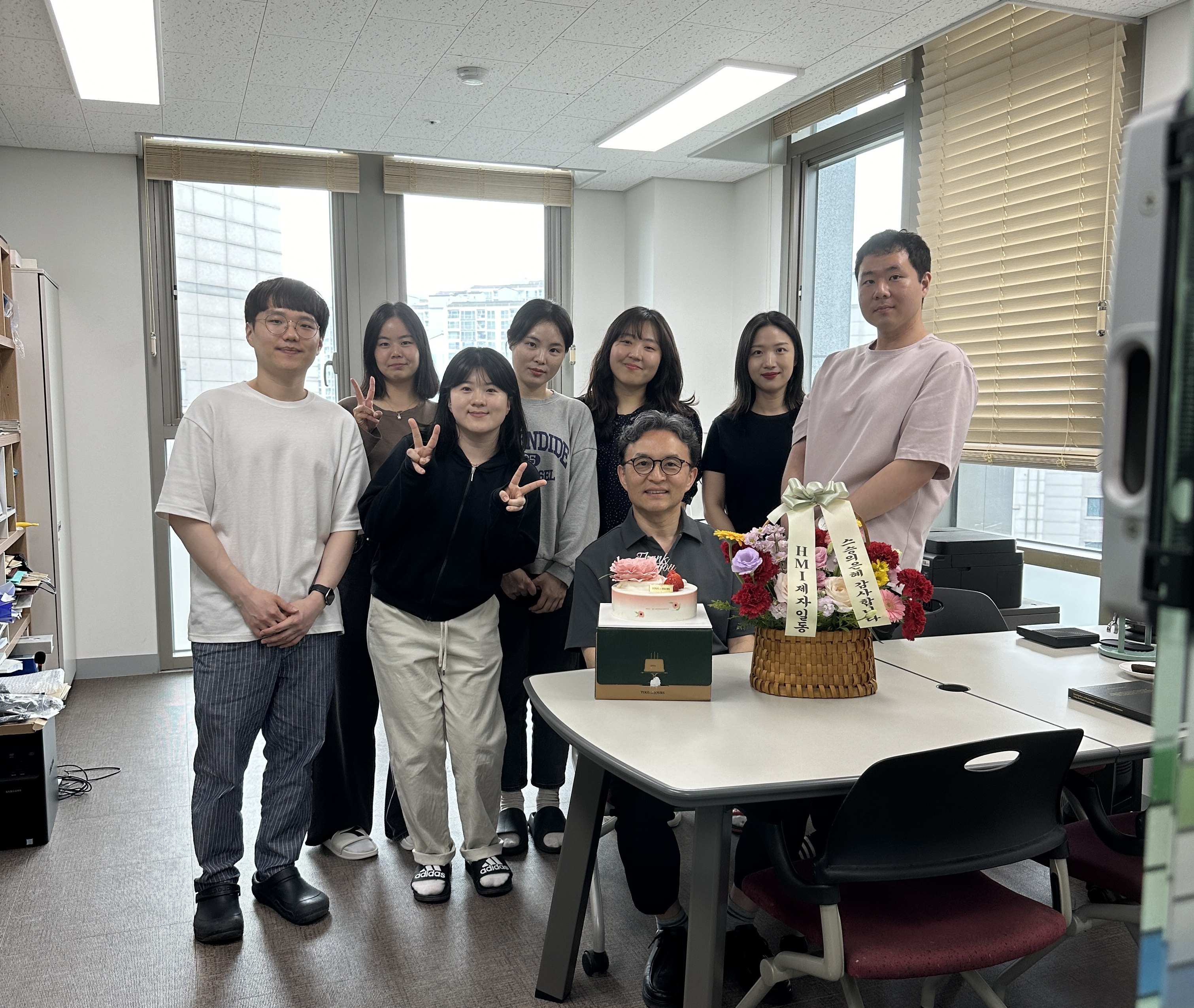
▲ Teachers’ Day celebration
Q. What stands out about Professor Kim?
Deokmin: I am impressed by how he asks questions rather than always giving us the answer right away.
Juwon: I remember him saying, “You cannot know something until you try it,” and “A re-searcher should always think about why.”
Q. Your relationships with one another seem very close.
Yumin: We share cake whenever a member of the laboratory has a birthday. We also take four-cut photobooth pictures after work. We share our experimental results and discuss them togeth-er. Sometimes we get so absorbed in the discussions that we leave work later than planned, but we enjoy it.
Juwon: We also make small coffee bets or share MBTI results and those of other popular per-sonality tests.
Daehee: I remember a day when I was frustrated because the experimental results differed from what I had expected. The senior members stayed with me until they left work and helped ana-lyze the cause. That was when I realized that this is a supportive place where we think together and grow together.
Q. In what area do you feel you have grown the most in this laboratory?
Daehee: My ability to solve problems independently. In the past, when an unexpected problem arose, I would first feel at a loss. Now, I first think, “Why did this result occur?”
Yumin: I have learned to accept unexpected failures as part of the research process.
Juwon: As more junior members have joined the laboratory, I have naturally developed a stronger sense of responsibility and leadership.
Q. What are your goals for the future?
Yumin: I want to identify the mechanisms underlying unresolved diseases and contribute to their treatment.
Daehee: I want to become a researcher who can help restore a healthy gut environment in mod-ern humans. I want to clearly demonstrate, through data and experiments, how gut microorgan-isms affect our bodies.
Deokmin: I want to become a researcher who contributes to the discovery of new treatment strategies or biomarkers.**
Q. What kind of students would you recommend this laboratory to?
Juwon: If you enjoy research and the process of developing and testing your own hypotheses about invisible phenomena, I definitely recommend giving it a try.
Daehee: The process of directly exploring and uncovering how profoundly microorganisms af-fect our health is fascinating in itself. If you are curious about the gut microbiome ecosystem, often called “another universe” within our bodies, you will surely enjoy conducting research here.
Humans are not organisms that exist alone, but organisms that coexist with countless microor-ganisms. True health is achieved when the human body and the microorganisms within it inter-act in balance. By studying microorganisms, the Human–Microbe Interaction Laboratory asks profound questions about human health. The changes in the gut microbiome that the laboratory uncovers will become important beacons illuminating the future of medicine.
* Antibiotic scar: A state in which changes in the composition or functions of some microorgan-isms remain for an extended period after the gut microbiome ecosystem has been disrupted by antibiotic use, potentially affecting health.
** Biomarker: A biological indicator that objectively reflects biological changes in the body, such as changes in proteins, DNA, RNA, or metabolites. Biomarkers are used to diagnose dis-eases, assess disease progression, and predict responses to treatment.
Tips from Professor Kim Heenam’s Team of Gut Microbiome Experts
How to Manage Your Gut Microbiome
To maintain good long-term health, it is important to distinguish between foods that should be consumed and those that should be reduced or avoided, and to put this knowledge into practice in daily life. Although specific dietary recommendations may vary depending on an individual’s health status and age, people generally benefit from consuming adequate amounts of protein, healthy fats, vitamins that are often lacking, such as vitamins D and B, and dietary fiber and fermented foods, such as kimchi, which help activate the gut microbiome. Conversely, it is ad-visable to reduce foods high in sugar or starch, foods containing excessive amounts of omega-6 fatty acids, and highly processed foods.