- writing date 2026.10.13
- author Communication Team
- hits 2
PEOPLE
CEO of NC AI Lee Yeon-soo
(Department of Computer Science and Engineering, enrolled in 1996)
Evolving into Intelligence that Solves Real-Life Problems
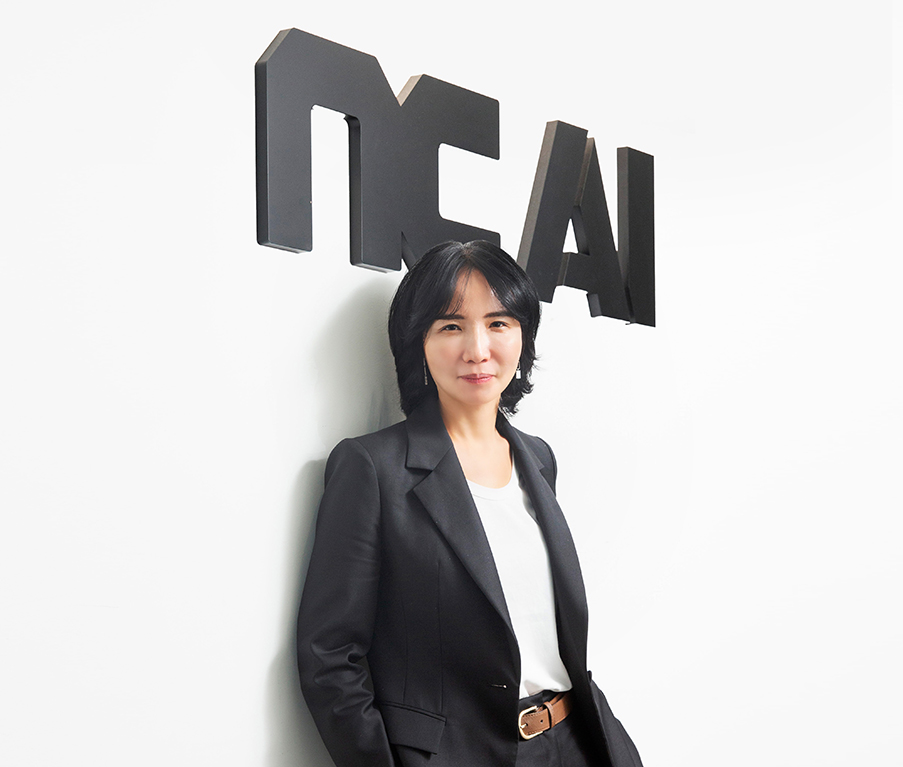
AI is evolving into a technology that realizes imagined worlds, and is no longer a mere tool that answers human questions. Beyond writing, creating images, and adding sound, the role of AI is rapidly expanding into pre-learning the spaces where robots will move and realizing reality within a virtual space. Amidst these changes, Lee Yeon-soo, CEO of NC AI talks about an era where anyone can become a creator or a director. As a leader of NC AI, his journey leads to a single question: How does technology expand human potential?
A Student in the Department of Computer Science and Engineering Who Did Not Have a Computer
The reason that CEO Lee Yoen-soo chose to major in Computer Science and Engineering is clear. He liked mathematics and science, and also wanted to create practical technology. It was a time of transition from DOS to Windows, a period when the Internet and web-based systems were just beginning to spread. The anticipation of personally creating future IT technology led him to the Department of Computer Science and Engineering.
However, when he entered the Department computers were not a widespread household good. His family did not have a computer, and it took time for him to understand programming and the internal structure of computers. “During my first and second years at college, I was really bushed just catching up with my classes. It is awkward to ask about something I don’t know at first, isn’t it? However, thanks to many kind friends around me, I was able to ask questions and receive a lot of help, which helped me adapt to the new environment. I felt absolutely unfamiliar with programming at first, but it became fun little by little starting around the third year.”
In the beginning, his experience at KU was not a confident one, but a time of adapting to an unfamiliar world, learning, and discovering his interests.
A Path of Learning Encompassing Both the Practical and the Academic
After graduating from college, CEO Lee joined Samsung SDS. At that time, companies and organizations were actively adopting web-based systems, and Samsung SDS was a representative company that carried out such system integration projects. Here, he gained experience in major projects, such as the Samsung Electronics service call center integration system and the dam construction management system of the Korea Water Resources Corporation.
In particular, the Samsung Electronics service project left a strong impression on him. It was a large-scale system that received customer inquiries via phone or email, assigned them to the appropriate region and technician, who then analyzed them. While working on major projects along with approximately 100 co-workers, he learned not only program development but also the optimal way to communicate with customers and to view the system as a whole. In addition, he felt a strong desire to return to academia. “I worked in the field a lot at the time, and it developed a thirst for learning. I enjoyed building customized systems for clients by integrating various technologies, but I came to want to personally create the core solutions.”
After entering a master’s program in 2006, he began to research natural language processing and AI. AI did not attract much attention at the time, but actually this appealed to him. Unlike technologies that were already widely used in the field, such as operating systems, networks, and databases, AI looked like an unknown area. Moreover, unlike existing programing where humans create rules one by one, the technology through which machines make their own decisions and act on that basis was a novel field that offered many things to learn and explore.
Seeing the Potential of AI in the World of Games
After completing his master’s and doctoral studies, CEO Lee joined NC in 2014. At the time, the combination of a game company and a natural language processing was much more unfamiliar than it is today. However, he saw the potential of AI in the domain of games. “Games are completely programmed things. So I had the expectation that operating AI in a perfectly controlled environment like games would allow better implementation of chatbots or natural language processing technologies.”
He worked on two types of AI project in NC. One focused on technology for game development, operation, and user experience, and the other was related to technology for expanding the game business into a new industry. A prime example is the baseball app PAIGE. Online baseball is a rich domain encompassing data, text, and video. The PAIGE system converts incoming game data into natural language sentences in order to present them as news articles, summarizes news, and gives information on starting lineups and game details using chatbots. It is a system in which natural language processing, video technology, and data science are all integrated in order to provide various features such as video highlights and player statistics. Lee described it as a showroom for AI technology implemented in the domain of baseball.
The real-time translation engine used in games was also a significant achievement. In global games, players from various countries communicate in real-time within a single party or guild*. If an instruction on where to go is delayed or the names of in-game items or dungeons are mistranslated, play itself could be ruined, but it was difficult to accurately handle the unique terms, abbreviations, and context in games using general translators. NC’s translation engine was developed to resolve these issues.
*Guild
: A group in the form of an alliance formed by players in NCSoft’s MMORPG Lineage series in order to engage in combat and community activities together
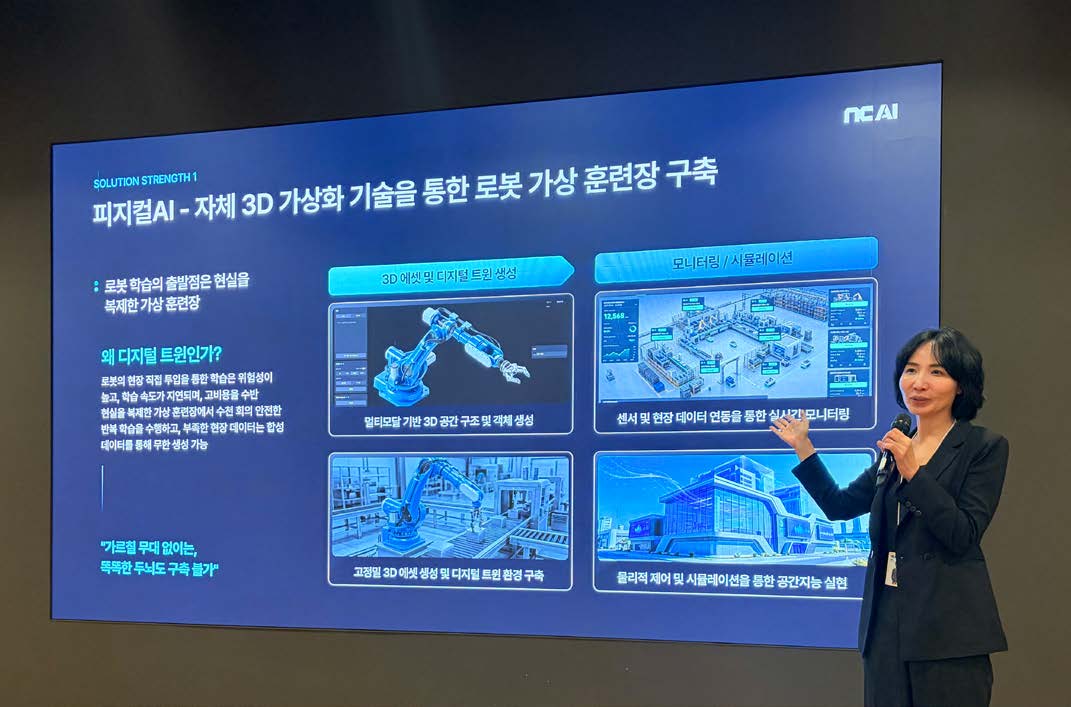
▲ CEO Lee Yeon-soo presenting on the current status of NC AI’s Physical AI
at the company-wide town hall meeting in May 2026

▲ NC AI Headquarters
At the Forefront of Expanding AI Technology: NC AI’s Challenge
Content generation and physical AI are the areas that NC AI is currently focusing on. CEO Lee identifies the company’s distinctiveness in its 3D and video-based technologies and multi-modal AI technology. A game is not a video. When a player strikes a character, it should fall over; if a player shoots a gun, the target should be hit; and if a player throws a bomb, the environment should be destroyed. In other words, objects within the game must exist as interactive 3D assets**.
VARCO 3D, developed by NC AI, is a technology that uses AI to provide assistance in 3D production, which requires significant time and effort. It can be applied not only to games but also to various other content areas, such as animation, broadcasting, and media production. In addition, it offers sound solutions that can analyze the necessary sound effects and voices based on videos, images, or prompts, and generate and modify them layer by layer. These technologies are expanding into the area of solving problems in industrial settings, beyond content creation. VAETKI, the multimodal AI solution from NCAI introduced at the end of last year is an industry-specific AI model designed for the upgrading of processes in key industries. It first provides a commerce service for fashion sellers, automated content creation.
3D and multi-modal technologies are also linked to physical AI, which has recently been receiving attention. Physical AI is a technology that enables moving machines such as robots to understand their surroundings, predict future situations, and plan their own actions in the real world. CEO Lee described his work as creating the robot’s brain.
“It requires a lot of trial and error for robots to learn something in the real world,” says CEO Lee. “However, we cannot intentionally break products in a factory or repeatedly stage dangerous situations. Instead, we create a factory or work environment in a virtual space, and accumulate data on what happened when a robot attempted various movements within it. A robot trained on that data can be assigned tasks without trial and error after going through a simulation of the real world.”
The 3D virtual space construction technology that NC AI has built up over a long period demonstrates its strength at this point. “Content and physical AI technologies meet at the point of the 3D virtual environment. They can be seen as technologies that create intelligence for virtual spaces.”
This technology can be expanded into various industries, such as manufacturing, national defense, and broadcasting. In manufacturing, there is increasing demand to replace workers engaged in strenuous tasks or processes that are experiencing a shortage of skilled laborers with robots. In addition, in the national defense sector, continuous attempts to have robots take over dangerous tasks have also been maintained.
**3D Assets
: Three-dimensional digital components used in the creation of games, videos, and virtual spaces
An Era Where Anyone Can be a Creator or a Director
The vision of NC AI related by CEO Lee can be summarized by the phrase “Anyone can be a creator,” and recently, the expression “Anyone can be a director” has been added. As AI assists with more aspects of the production process, the human role does not disappear but changes. What is important now is the ability to decide what to create, to identify what problems to solve, and to coordinate technology and humans in order to lead the organization in the desired direction. “Ultimately, we need to be both designers and people who can identify problems. The final decision on what to do with AI belongs to humans.”
Here, we can see the reason that CEO Lee talks about the necessity of the humanities. We are facing an era in which AI and robots take charge of various tasks such as coding and system management, and some tasks in production settings. However, it remains up to humans to decide what leads to a good outcome, what is beautiful and fun, and what direction should be followed. As AI is increasingly used as a tool for creation and industry, humans need to ask more profound questions and to form a broader perspective.
Hope You Grow into a Person who Contemplates and Identifies Worthwhile Work for Yourself
CEO Lee described college as a safe buffer zone where one can engage in trial and error. He advised KU students, saying, “It is more important to take the long view and have diverse experiences than to focus on a single grade or mistake. I hope you experience honorable failure from which you can grow, part-time work, and collaboration with others, in this way going beyond studying alone.” He especially emphasized the power to identify the work one must do oneself.
“When you graduate and enter the professional world, there will not always be someone who stays close and organizes your tasks into a list of priorities. You will find gaps between tasks many times, which will lead you to consider what else needs to be done in order to complete the task for a major project. In addition, the ability to achieve good results on one’s own is not enough. You need to have the capacity to work with others and find answers even amidst imperfect and sometimes irrational situations.”
CEO Lee, who is solving real-world industrial problems based on virtual world implementation technology, asks the role of humans again at the forefront of AI technology. “As technology enables us to do more, we must ask ourselves more clearly what we want to create, what problems we want to solve, and what kind of world we want to journey toward. Those who keep these questions in mind can become the true leaders of this AI era.”