- writing date 2026.10.13
- author Communication Team
- hits 2
PEOPLE
Emeritus Professor Kim Eon-jong of the Department of Sinographic
Teach Hanja Well Today
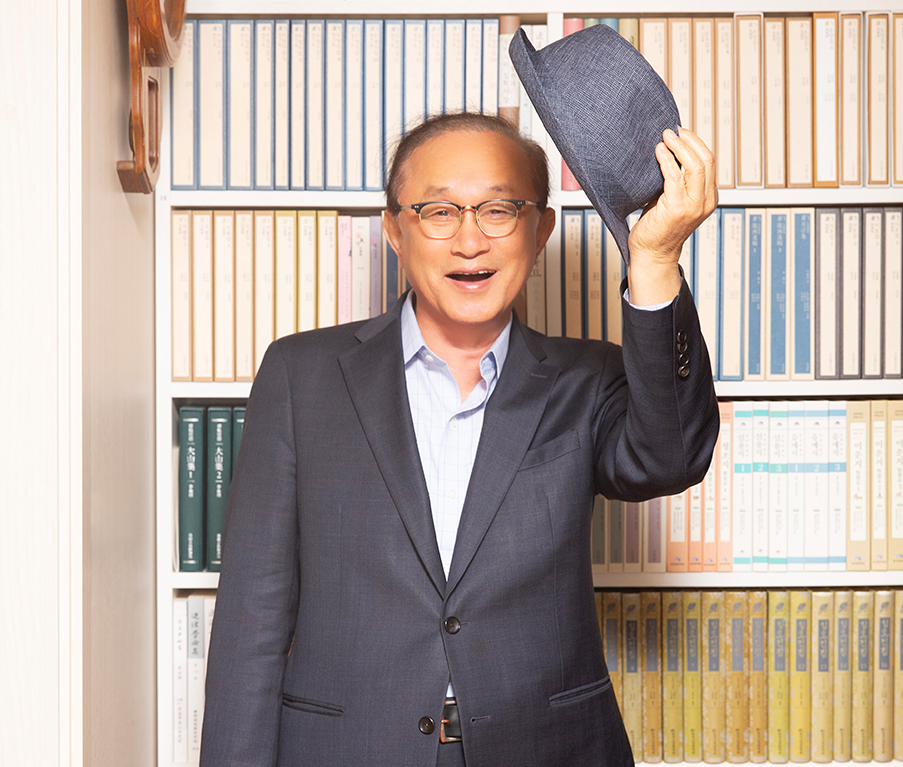
Professor Emeritus Kim Eon-jong of the Department of Sinographic Literatures has finished his three-year term as President of the Institute for the Translation of Korean Classics. Professor Kim, who has dedicated himself to the modernization and globalization of Korean classical literature, is also the creator of the YouTube channel Hanjalal: Teaching you Hanja (Chinese characters), which has over 10,000 subscribers. In Hanjalal, an elderly gentleman wearing a stylish fedora gives accessible and interesting explanations of the meanings of celebrities’ names in Hanja, including NVIDIA’s Jensen Huang and his favorite signer Hwasa, as well as of the Four Books and Three Classics through the program of the same name.
The Confucian Silver Spoon and the Taedong Institute for Classical Studies
Growing up in Andong, Professor Kim Eon-jong learned about the field of Confucian studies from his maternal grandfather and father, who were Confucian scholars. As he learned not only Confucian writings and books but also the attitude of a Confucian scholar from them, it is natural to say that he was born with a Confucian silver spoon in his mouth.
“My maternal grandfather and father lived their entire lives as Confucian scholars. People call it Yu kyo, but Confucianism is not a religion but a philosophy of life. It is about striving to live a life based on the doctrine of the innate goodness of human nature, a fundamental tenet of Confucianism, along with the belief that all human beings are born with benevolence, righteousness, propriety, and wisdom.”
“While attending college in Seoul, I learned Hanja at the Taedong Institute for Classical Studies, which focused on classical Chinese literature, founded and led by Im Chang-soon (Cheongmyeong). He was renowned as the best Hanja teacher in Korea, after he was dismissed from his faculty position for political reasons.”
“As he was such an outstanding teacher, students not only majoring in classical Chinese and Korean language and literature but also in history and philosophy flocked to his classes. I took classes alongside Park Byung-won, Chairman of the Toegye Research Institute, and Ahn Byung-gul, a professor at Andong University. Since I was learning from the best teacher in Korea, I committed myself to learning Hanja, feeling a sense of duty to study hard even if I was not bright enough (Laughs).”
One of the Joys of Being a Gentleman: Teaching Students at Korea University
His studies deepened day by day, leading to studying abroad at National Taiwan Normal University. After returning to Korea, he began teaching at Korea University in the spring of 1995. Professor Kim says, “According to Mencius, one of the three joys of being a gentleman is teaching talented people from all over the world. What a great blessing it has been to teach bright and ambitious KU students every day. It was also impossible to describe how happy I was to cultivate students who were even more competent than myself.”
Professor Kim emphasized Geukgibokrye, overcoming one’s own desire or selfishness and returning to propriety, to students. “When we observe courtesy and respect for each other, our society truly becomes a place worth living in together.” He also introduced a passage from a letter written by Toegye Yi Hwang to his grandson, which says “Do not be too careless just because you are husband and wife,” and smiled saying that wisdom from hundreds of years ago still applies today.
Benevolence, Righteousness, Propriety, and Wisdom Explained by Hanjalal
Benevolence refers to love.
It is a philosophy of generosity and forgiveness, which teaches us not to hate others, but to forgive and love them.
Righteousness refers to clear conscience.
It implies a life that is upright and not shameful in the light of conscience, so that there is no shred of shame when looking up to the sky.
Propriety refers to respect.
It teaches us that we should respect each other. Just as we keep a safe distance from other vehicles on the road, we should show respect and keep an appropriate distance from each other.
Wisdom refers to the ability to understand the world.
It teaches us that we should explore the world and set a goal for the way we live our lives.
The Start of Hanjalal: Free Lectures on the Four Books and Three Classics
He first began offering free lectures based on his experiences during a sabbatical at the State University of New York (SUNY). He was pleasantly shocked while teaching at a Korean language school at the request of Korean-Americans.
“Even though these Korean-Americans were working hard in one of the most fiercely competitive cities, New York, their children were showing amazing dedication to preserving the Korean language, culture, and the spirit of the nation. They even contributed their own money to ensure that their children would not be left behind. Watching their dedication, I felt ashamed as an educator and a scholar. With the determination that I also should do something helpful in terms of education, I made a proposal to Director Kwon Dae-bong of the Korea University Lifelong Education Institute upon returning to Korea, and launched a free public lecture course titled the Four Books and Three Classics.”
The free lecture course, offered by Korea’s top classical Chinese scholar every Wednesday from 6 to 9 pm, was a great success. The classroom was packed with approximately 150 students each time, and the program continued for 17 years. Although it was unfortunately halted during the COVID-19 pandemic, Professor Emeritus Kim decided to become a YouTube creator, as requests from the public to teach Hanja and classical literature continued thereafter. His son and daughter also actively supported his new initiative. The witty channel name Hanjalal and the humorous banner image were also completed with their unsparing support.
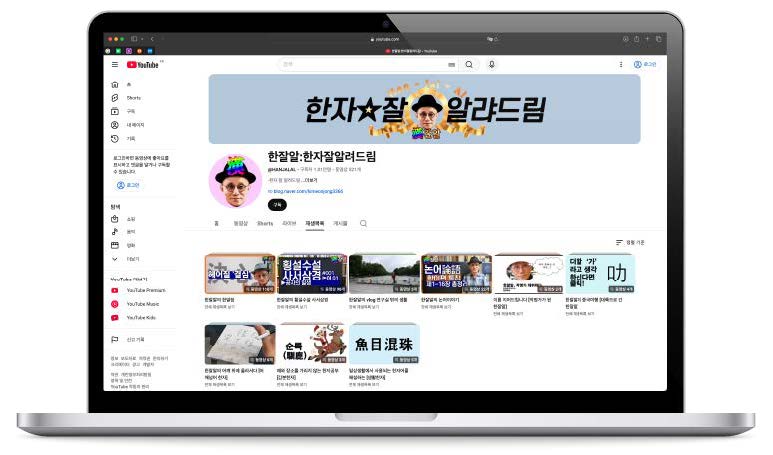
▲ Hanjalal (Teaching you Hanja well) youtube.com/@HANJALAL
Running the Hanjalal Channel to Foster Better Korean Language Skills
“Although this YouTube program began at the request of people who took my Four Books and Three Classics lectures, its goal is to attract people to Hanja, and ultimately, to help them improve their Korean language skills.”
He regretted that the decline in Hanja education has weakened writing ability and, furthermore, has undermined Korean language skills.
“If the Korean language is an ocean, Hanja can be seen as the streams and rivers flowing into it. Approximately 70% of the Korean language today consists of words derived from Hanja. As Hanja is a part of the Korean language, the understanding and handling of it is directly related to Korean language proficiency. You might wonder why it is important to be proficient in Korean. It is to communicate well. Communication is the most important thing in our society. We can better understand each other through proper communication.”
Although he is a professor of classical Chinese literature who places such importance on Hanja, Professor Kim calls himself an abolitionist of Hanja.
“Even when translating classical literature, I try to seek out and find genuine Korean words, avoiding using Hanja words as much as possible. I strive to capture the flavor of the Korean language. However, instead of rejecting Hanja, we should assimilate it in order to enrich our language, since Hanja is one of the valuable weapons Koreans have.”
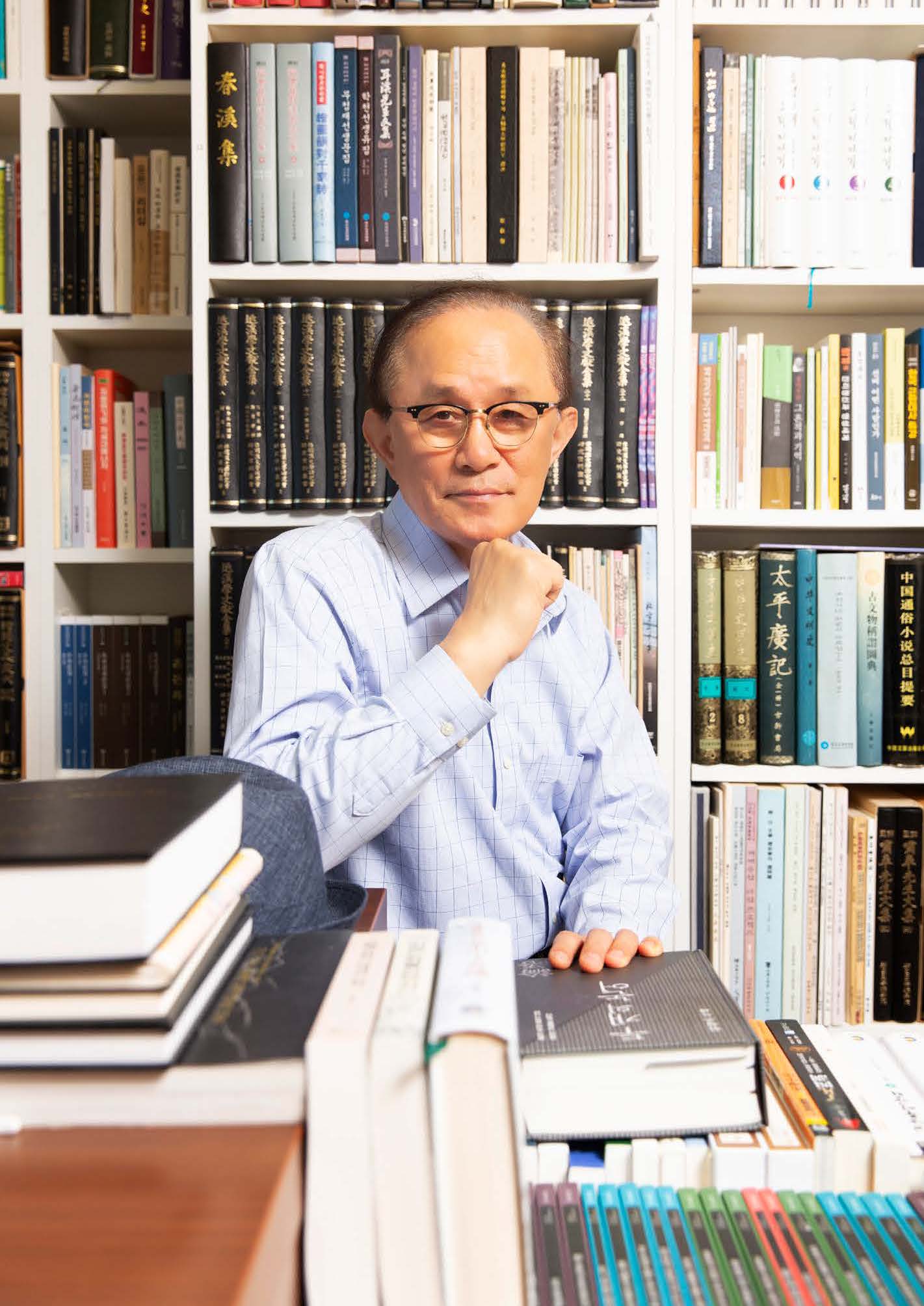
▲ Professor Emeritus Kim Eon-jong
The 6th President of the Institute for the Translation of Korean Classics Promotes K-Classics to the World
Serving as the President of the Institute for the Translation of Korean Classics, which plays a leading role in conducting national projects in the field of classical literature translation, since 2023 Professor Emeritus Kim has dedicated himself to the accessibility of classical literature through translation.
“The Institute for the Translation of Korean Classics translated the entire Annals of the Joseon Dynasty and created a database so that anyone can search through it and understand it on its website, which is an immense task that neither China nor Japan had even dared to attempt. Korea is the only country where the government supports this kind of project, so I hope that all Korean citizens take pride in it. However, there are still numerous classical Korean works that have not been translated yet. It is wonderful to translate classical works written with absolute care and dedication by so many great intellectuals, ranging from Cheo Chi-won to scholars of the late Joseon Dynasty, into modern Korean. In Korea, almost everything had been written in Hanja for 2000 years since its introduction.”
In particular, during his tenure, along with the Institute for the Translation of Korean Classics, he has promoted the globalization of Korean classical literature (K-classics) through English translations of classical Korean works, including those done by Choe Chi-won, Heo Gyun, and Park Ji-won. He firmly stated that the spiritual culture and classical works produced by our ancestors have sufficient value to compete with Western classics on the world stage.
“If people around the world have a chance to read the writings of our ancestors, they will be amazed by Korea’s historical and cultural heritage. They will marvel when realizing that there was a people who engaged in such deep contemplation in such a small Eastern country long ago. These days, even we ourselves do not fully realize how great our ancestors were. However, if we can understand the records they left behind, we will be able to properly appreciate them. There is no need to reject or overcome Hanja. Rather, we should assimilate it. With internalized Hanja culture and our unique cultural heritage left by our ancestors, we should step forward in the world. We must not throw the outstanding spiritual and cultural heritage painstakingly handed down by our ancestors into the trash.”
The AI Era: The Ultimate Keyword is “Heart”
Finally, Professor Kim was asked about his prescription for future generations living in the age of AI. “The most important thing for humanity is not intelligence but the heart. How we use our hearts is the core of our lives. Confucius, Mencius, Toegye and Yulgok all place great importance on the heart. The survival of modern humanity will be associated not with technology but with how we use our hearts. Maintaining a warm heart, one that accepts, forgives and helps others will help humanity stay alive. Reflecting on and refining one’s heart, and understanding each other, are the dimensions of the humanities that should be adhered to, as well as remembering the power of the classics. I hope you never forget that this is the way to live a human life and to reveal your value as a human being amidst any technological changes.”
After the interview, he put his fedora back on and turned on the interactive whiteboard in order to display the YouTube channel Hanjalal. While describing himself as perhaps the last person belonging to the Hanja generation, Professor Kim strives to teach the value of Hanja and classic literature as long as his strength allows. The sincerity of his heart is spreading across borders and generations through his YouTube channel.