- writing date 2026.10.13
- author Communication Team
- hits 2
THEME-Special
Professor Kwon Bo-due rae (Department of Korean Language and Literature)
of the March 1st Movement
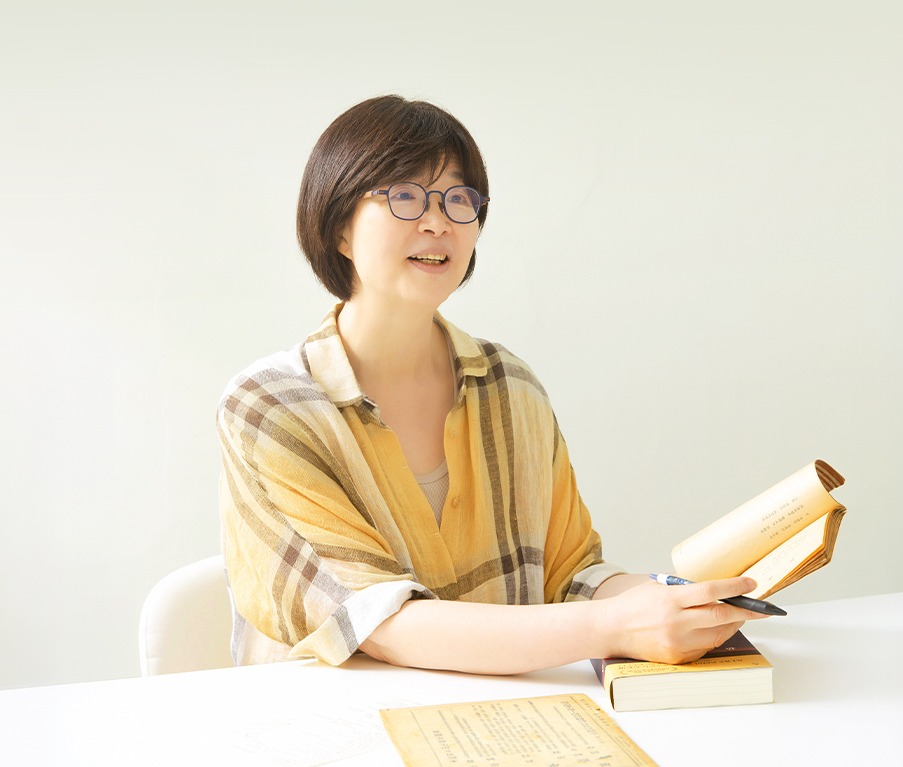
“As a professor in the Department of Korean Language and Literature, I can delve into a great many things, including literature, history, and philosophy.”
The Night of March 1st is a comprehensive overview by a scholar who has studied the March 1st Movement for a long time, an event that every Korean knows or thinks they know. Professor Kwon Bo-due rae in the Department of Korean Language and Literature said that she examined revolutions in India, Mexico, and Haiti in order to understand the March 1st Movement. What made her so deeply immersed in studying the March 1st Movement? How much do we really know about the familiar March 1st Movement?
As a specialist in modern fiction, is there any particular reason you chose to focus on the Enlightenment period at the end of the Joseon Dynasty?
-Tracing history back step by step, I arrived at the late 19th century. It was really fun to examine old writings and the social history of the time, and to ponder on the thoughts that led people back then to leave behind such records and traces. Understanding that era helped me understand my present self. As Korean society in the 1990s greatly influenced the formation of Korean society in the 2020s and myself, understanding history has helped me to logically trace the formation of my current self. I loved the sense of liberation that came from immersing myself in that work.
The early 1900s was just about a century ago, but the way people behaved was really different from us today. In around 1909, some students gathered to gaze at the moon, write poems, and sing songs. Amid this, they reached a resolution saying, “Let’s sacrifice our lives for the country. Let’s cut off our fingers as a pledge,” and they actually cut them off. This is really hard to understand from today’s perspective. However, this period is the origin of 20th century Korea.
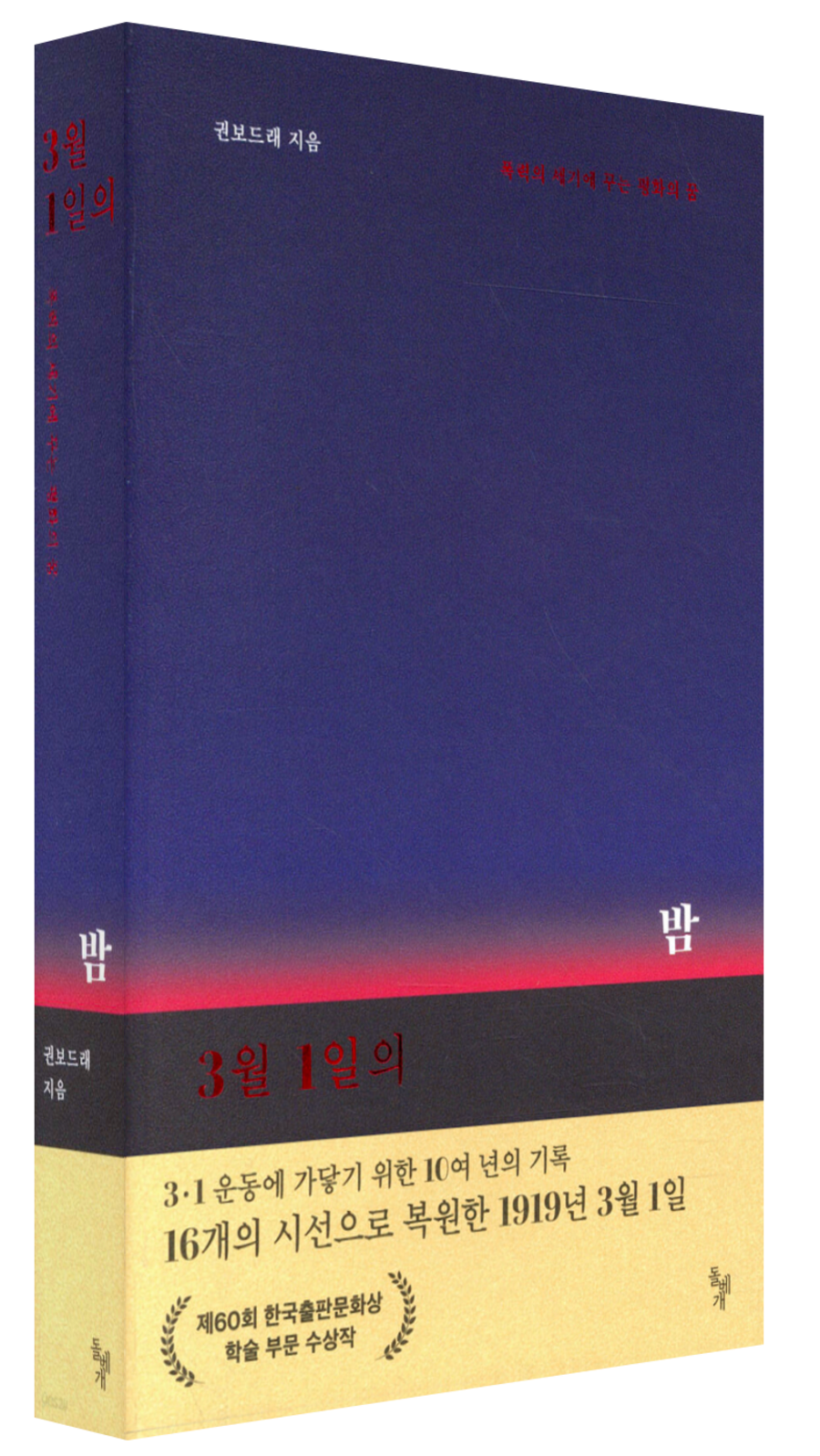
▲ The Night of March 1st by Kwon Bo-due rae
What is the reason for you became immersed in the March 1st Movement?
-The massive changes brought about by this movement were amazing. Although all data say that there were great changes in our society after the March 1st Movement, I could not really understand the reason behind it, so I dug through the data to understand.
The interrogation records from that time are really shocking. They contain vivid and diverse details. When a fierce prosecutor interrogates a man about why he shouted “Manse,” the man makes excuses by saying, “I thought Korea had become independent,” “I don’t even know what Manse means” or “I had gone to the restroom at the time.” Those who had been trying to avoid suspicion once again cut off their fingers to create bloody flags. Even after seeing neighbors gunned down while shouting “Manse” in the morning, they would gather again to march in the afternoon. A century ago, when the Internet and online group chats did not exist, protests began without any central organizations and took place day and night across the country. Why did those ordinary men and women risk their lives in pursuit of peace?
I was reminded of the opening lines of A Tale of Two Cities by Charles Dickens.
It was the best of times, it was the worst of times, it was the age of wisdom, it was the age of foolishness…
we had everything before us, we had nothing before us…
Everything Dickens described about the French Revolution was also there in our March 1st Movement. While researching the data, I became convinced that the March 1st Movement constitutes a rich strain of thought and a source of stories comparable to the French Revolution, and I also felt a sense of regret that we have seen it from a severely fragmented perspective.
“3·1 The March 1st Movement is represented by the day, the marketplace, and the Taegeukgi,
but on the other hand, it was also an event that took place at night, including “Manse” shouted from the mountaintops, and the waving of flags proclaiming independence.
While it ended in early March in some places, it began in December in other places.
It was a huge, peaceful protest on the part of some people, while it was an experience of raiding a town office on the part of others.
As such, the March 1st Movement has many faces.
- The Night of March 1st by Kwon Bo-due rae, p.500
Since it is such a well-known event, we might only have a fragmentary knowledge of it.
-We may think that the March 1st Movement is an historical event that is irrelevant to our lives, in which extraordinary historical figures were involved, but as seen in their vivid accounts preserved in the records, it was truly an event where ordinary people like us showed courage out of their love for the country and their neighbors. These people included not only the patriot Yu Gwan-sun but also her female cellmates. The story of ordinary people who suddenly joined the movement can be even more touching: Jeong Geum-juk, a twenty-one-year-old gisaeng in Seoul who stood at the Jongno intersection, shedding tears of excitement; Song Jun-pil, a scholar who tore up the floorboards of his classroom in order to print a proclamation using a woodblock instead of a printing press; Kim Jeong-hee, a twenty-four-year-old woman in Yeongcheon, Gyeongbuk, who, having spent a sleepless night after hearing the news of the Manse protest, was arrested for shouting “Manse” while waving a flag of independence at daybreak on the street alone.
Why did you focus on the ‘night’ of that day?
-Most of us know the March 1st Movement only as a daytime protest and the records related to that. However, that night people held beacon-fire protests and climbed over the mountains in order to protest. In addition, the participants did not just have a daytime face, or a single motivation. Some joined the protest because they wanted to take control over their county, while some were afraid of being ostracized for not participating. I wanted to clearly see faces that are difficult to distinguish in the dark at night, and the thoughts they reveal.
The March 1st Movement is notable for students’ leadership and spirit.
-The March 1st Movement is the first event in Korea when young students stepped to the forefront of history. In previous riots or rebellions, young people did not step forward. It was the first experience of students with new knowledge spearheading social change, and this spirit later became the origin of the April 19 Revolution and the June Democratic Struggle of 1987. However, if some say that today’s young people lack spirit compared to those in that time, I absolutely deny it. Youthful imagination and powerful action are necessary to change the world. Today’s young people will change the world slowly, spending time on pondering, compared to those in the past. I am optimistic about our young people. The March 1st Movement was also an event when not only students but also marginalized, vulnerable people with faint voices shouted loudly. Poor farmers, scorned butchers, and women forced into submission all shouted “Manse” at the top of their lungs.
I thought that I had overall knowledge of the March 1st Movement, but there are really many unknown stories.
-The March 1st Movement includes abundant events and stories that can serve as a key to the better understanding of modern Korea. The French Revolution is an event that continues to inspire and touch people around the world to this day, and the March 1st Movement is not inferior to it at all. I am certain that it can become a globally well-known incident. I hope to see it examined in many media in the future.
What are your thoughts on the notion that the humanities are in crisis?
-People have been saying “I am sorry for majoring in the humanities” for decades now. (Laughs). I think that there will be some restructuring of humanities majors. In the modern era, it was really important to show national pride through the humanities, but those times have passed. Even though scientific knowledge has become more important in our lives, it is still vital to explore and study how to live through the humanities. Even if a person has a successful life in a secular sense, it is difficult to truly enjoy their life without faith or conviction in the value of their own existence. So while the number of humanities majors might decrease somewhat, I hope that the humanities become the foundation of more people’s lives.
Why do you think that the humanities are necessary to more people?
-Average life expectancy continues to increase. How should we live this extended life? Science and technology are certainly important, but the humanities are essential for maintaining a life worthy of a human being. In this situation where life expectancy is increasing, the potential demand for the humanities could actually steadily rise. At the college or national level it is a shame that people only talk about immediate matters without discussing possible concerns in the next ten years. Now, it is time to think about the next 100 years.
What role should the College of Liberal Arts at KU play in the future?
-As I often say, if you don’t want to change, you must change. For example, there are soup researchers in the food lab at an instant soup company founded over 50 years ago. We may wonder what kind of research is needed for soups that always taste the same. In fact, it is not easy to maintain the consistent taste while responding to a great deal of change in dietary habits, production environments, and consumer preferences.
Of course, I hope that the Department of Korean Language and Literature continues to exist in the future. Even if the department system changes, I hope there will still be researchers who study Korean literature. However, to ensure its continuous existence and maintain its status and internal stability, we need to change approximately 30% of it, as is always the case. While engaged in this, it is important to maintain its essence. Just as other people working hard today do every day, we also need to strive to renew ourselves in order to adapt to this era. It would be wonderful if the College of Liberal Arts shows this quality in a flexible way.
Is there any ability that you hope KU students cultivate?
-The ability to maintain their curiosity. People nowadays immediately begin to search once they are curious about something. But why don’t we stay curious for a while, which is a great ability. I think there is no greater quality than becoming curious and loving something. We need to cherish and enjoy the moment when we feel curious about and like something, but unfortunately people leave these feelings behind too quickly. In this regard, I want to ask people not to settle for quick answers right away but to stay curious for a while.