- writing date 2026.10.13
- author Communication Team
- hits 2
THEME
Korea University Institute for Global Humanities Research and Collaboration
and MIT Students Read Hanjungnok
Exploring the Future of Korean Studies and Global Humanities
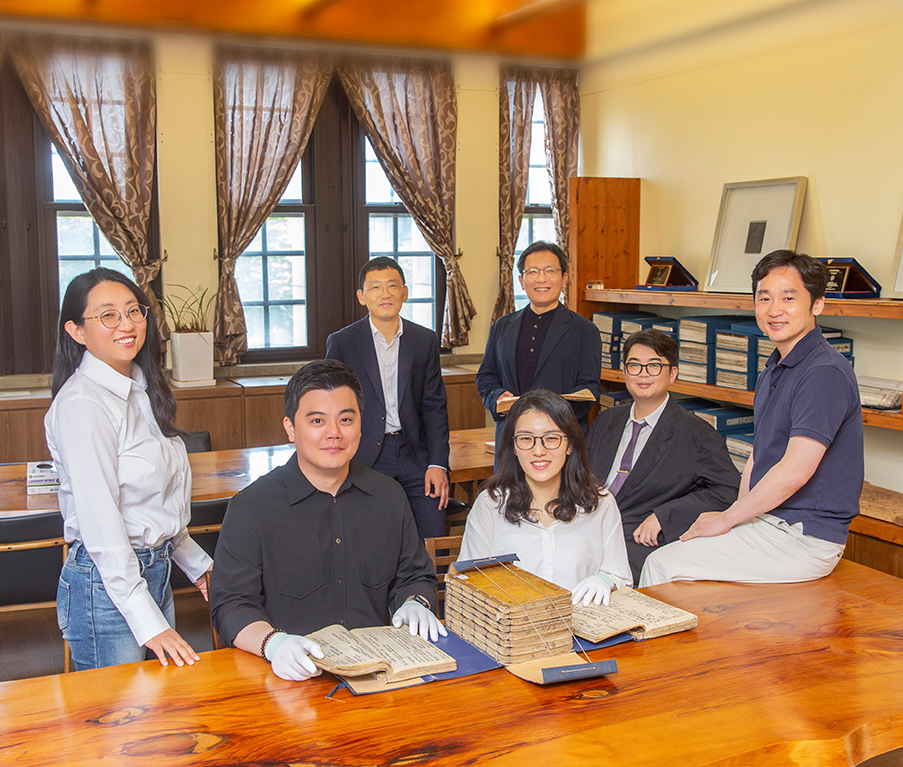
▲ Front row, from left: Lee Songhee, Kim Sungoh, Choi Gogyeong, Park Soochan, and Noh Johann (all research professors at the Korea University Institute for Global Humanities Research and Collaboration)
Back row, from left: Song Hobin (Professor in the Department of Sinographic Literatures) and Song Hyok-key (Professor in the Department of Sinographic Literatures and Director of the Korea University Institute for Global Humanities Research and Collaboration)
Who are we, what do we value, and what wisdom shall we pass on to the next generation?
As technology provides more answers, humans find themselves confronted with even more fundamental questions. Launched in January 2025, the Korea University Institute for Global Humanities Research and Collaboration conducts research with support from the Humanities Korea (HK) 3.0 program of the National Research Foundation of Korea, guided by the vision of “Redefining Korean Studies in the Era of Sovereign AI and Advancing a Global Hub for Comparative Humanities.” We visited the Institute, which brings together the Korea University Institute for Sinographic Literatures and Philology and the Korea University Center for Korean History to shed new light on traditional Korean studies while re-examining the role of the humanities in the age of AI.
Why the Humanities Matter Again in the Age of AI
AI can analyze vast amounts of information and generate sophisticated responses; however, the task of making value judgments and understanding and interpreting cultural contexts remains a human domain. The Korea University Institute for Global Humanities Research and Collaboration emphasizes that understanding human identity and cultural diversity is becoming increasingly important in the age of AI. Given that current large language models (LLMs) are trained on data predominantly from the English-speaking world, the world that AI comes to understand and reproduce may inevitably be skewed toward the perspectives of particular cultural traditions. The researchers at the Institute regard this bias not merely as a technical error, but as a structural problem that renders cultural diversity invisible.
These concerns have led to the Institute’s research on “sovereign AI” and “human-centered LLMs.” How can we preserve and expand the body of knowledge encompassing Korea’s language, history, and culture, as well as the diverse cultures of the world, in the age of AI? This constitutes a new role for humanities scholars, and, at the same time, serves as a compelling reason for their active participation in the development of AI.
In this process, classical texts serve as an important resource. Having preserved centuries, and in some cases millennia, of accumulated human experience and thought, classical texts provide a point of reference from which we can reflect on who we are and where we stand amid a rapidly changing world. The humanities are garnering renewed attention not merely for their role in interpreting the past, but also for their capacity to offer the wisdom needed to prepare for the future.
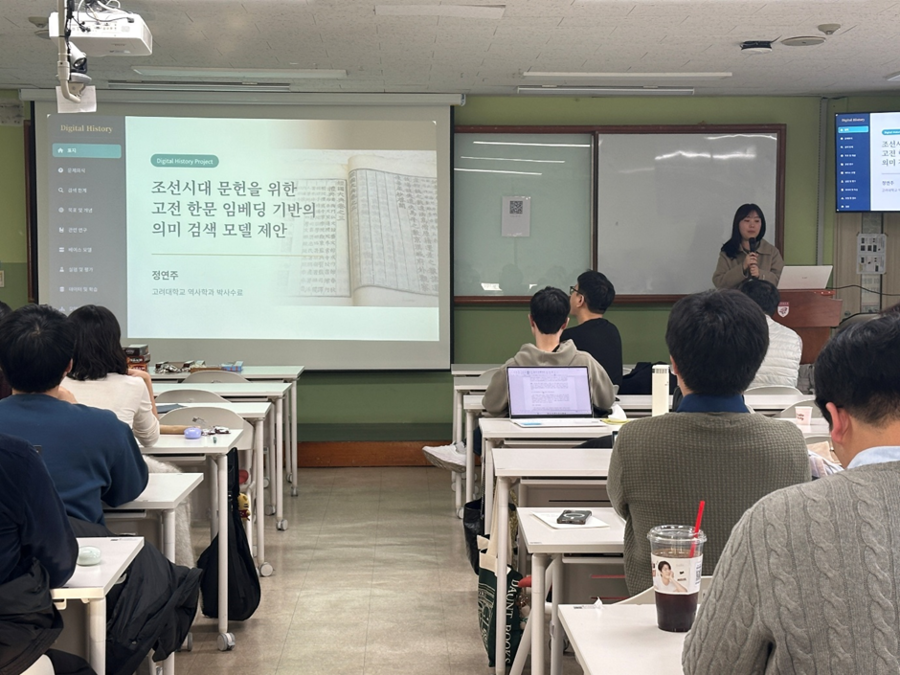
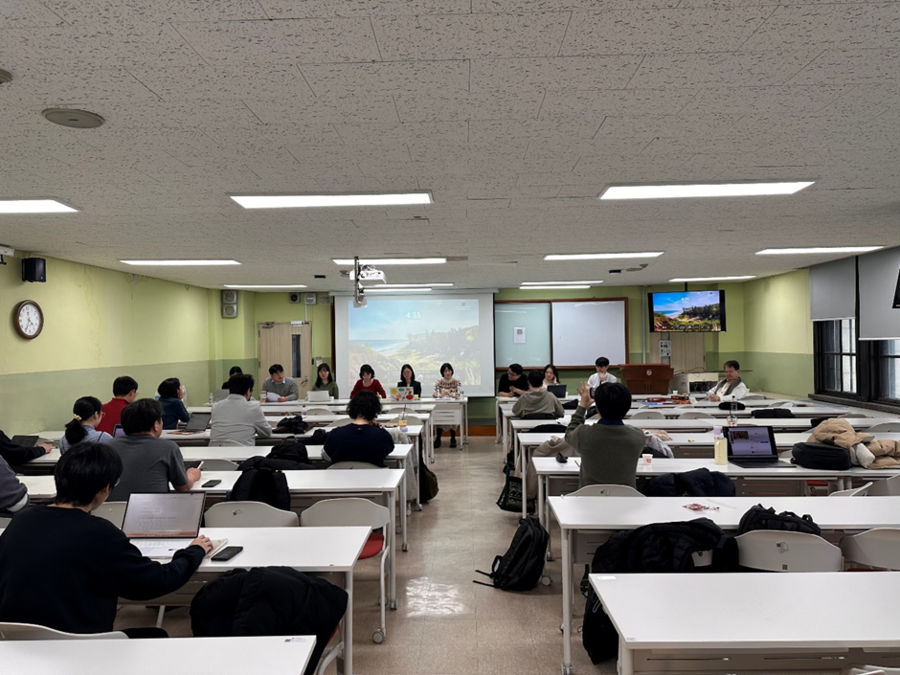
▲ A colloquium on research methodologies for AI-assisted historical studies
Humanities Research Evolving with AI
AI is transforming the methods through which humanities research is conducted. The Institute is actively utilizing AI to develop an English-language glossary for traditional Korean studies. For example, when considering how to translate and conceptualize specific terms from sinographic texts of the Joseon Dynasty, such as seonbi and gunja, into English, AI can quickly provide a wide range of relevant examples from existing English-language scholarship, enabling researchers to examine various translation possibilities and conceptual definitions. This significantly reduces the time required for literature and source searches, a process that took weeks or even months in the past.
Young researchers at the Institute are also incorporating AI into their individual research. At the AI-Based History Colloquium, the researchers presented on topics such as using an AI language model (SIKU-RoBERTa) to restore damaged passages in epigraphic materials (geumseokmun, inscriptions carved into metal or stone artefacts such as bells and monuments) from the Goryeo period, the employment of a semantic search model for the Veritable Records of the Joseon Dynasty (Joseon Wangjo Sillok), and the automated extraction of personal names and official titles from the Diaries of the Royal Secretariat (Seungjeongwon Ilgi) and the design of a corresponding database.
However, there clearly are areas in humanities research in which AI cannot yet replace human expertise. For example, when analyzing texts featuring gugyeol (Korean reading markers for Literary Sinitic) or eonhae (Korean translation and annotation of Literary Sinitic), AI can identify linguistic patterns, but understanding the historical evolution of interpretations of Literary Sinitic and their cultural implications remains the task of human researchers. Classical texts recorded in sinographs and Literary Sinitic preserve traces of people’s thoughts, emotions, and struggles across centuries. These texts require profound interpretation because they are not merely collections of information; rather, they embody the experiences and worldviews of particular historical periods.
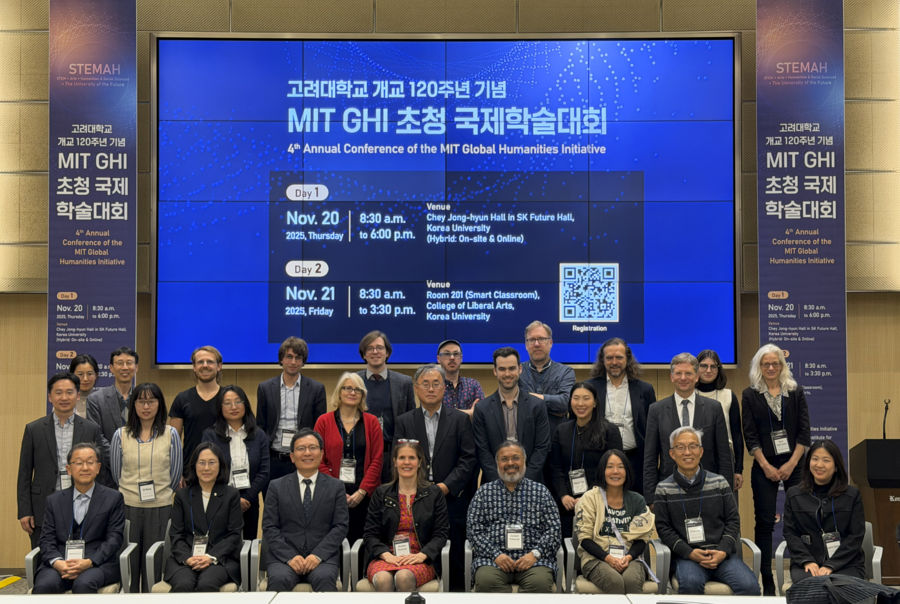
▲ Researchers attending the international academic conference jointly organized with MIT GHI
Korean Studies within East Asia
Today, Koreans Studies extends beyond the study of a specific geographical region. Korea was part of the East Asian sinographic sphere, a cultural sphere in which countries such as Korea, China, Japan, and Vietnam shared the common writing systems of sinographs and Literary Sinitic (a written language based on ancient Chinese) for more than two thousand years. While grounded in a shared intellectual tradition, the countries within this sphere have also developed their own distinct cultural traditions. Even as recently as a century ago, intellectuals across this region composed poetry, recorded scholarly reflections, exchanged letters, and drafted diplomatic documents using sinographs and Literary Sinitic. Today, this legacy is being re-examined as a shared heritage of humanity rather than as the tradition of a few specific states.
This is why the Institute for Sinographic Literatures and Philology, an organization affiliated with the Institute for Global Humanities Research and Collaboration, has adopted the concept of “Sinographic literatures and philology” as a replacement for the conventional term “classical Chinese.” This terminology is intended to emphasize that classical texts written in Literary Sinitic are not the exclusive heritage of China but were widely shared across this cultural sphere, while also reflecting the Institute’s commitment to studying the literatures and scholarly traditions of the various countries within it.
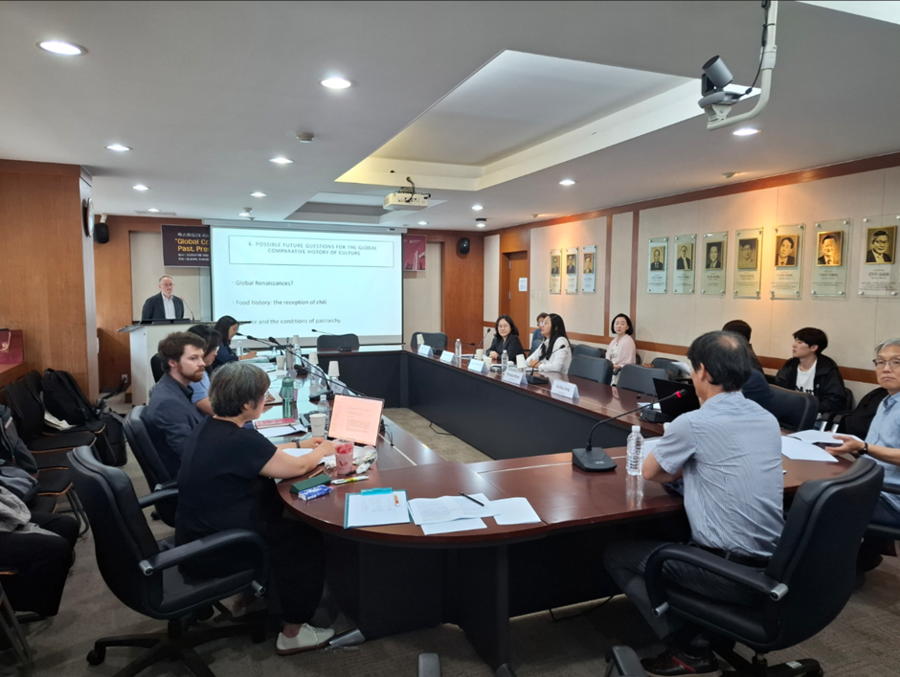
▲ Korea University–University of Oxford academic seminar
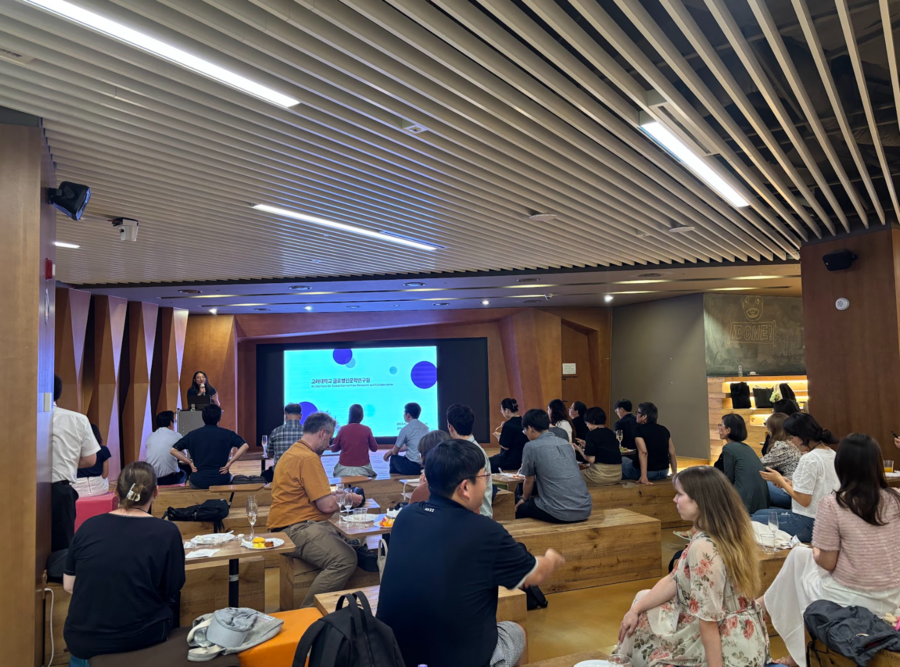
▲ An international exchange program for overseas Korean Studies scholars hosted by the Institute
Global Perspectives on Korean Studies
The Institute is expanding its research through a range of international collaborations. Notably, it has established a close partnership with the MIT Global Humanities Initiative (MIT GHI), through which it is exploring new directions for global humanities. Together with MIT GHI, the Institute has organized an international academic forum on the topic of “Catalyzing Human Flourishing in Uncertain Times” and has been continuing discussions on the role of future universities, focusing on the concept of “STEMAH,” which integrates Arts and Humanities with STEM (Science, Technology, Engineering, and Mathematics). These initiatives are grounded in the recognition that technological advancement alone cannot account for human flourishing and that an understanding of humanity and society must develop alongside education in science and technology. Building on these collaborations, the Institute is also participating in the establishment of MIT GHI’s East Asian studies research network, working to position Korea as a key hub for global humanities research.
Interest in Korean Studies among overseas researchers is also growing. One MIT student, for example, wrote an undergraduate thesis comparing and analyzing Hyegyeonggung Hong’s Hanjungnok (Memoirs of Lady Hyegyeong) and Han Kang’s The Vegetarian. By reading together the writings of a noble court woman from the Joseon Dynasty and a work of contemporary Korean literature, the student explored questions of human desire, repression, and freedom. This case demonstrates how Korean Studies is moving beyond the confines of a particular region to engage with universal questions concerning humanity and society, thereby evolving into a global field of study.
During his first trip to Korea, Professor Alan Strathern, a historian at the University of Oxford, visited Seoul and Andong and noted that the Joseon Dynasty’s governance model possessed distinctive characteristics that differed from those of China and Japan. He subsequently organized an international academic conference to investigate these characteristics from a comparative historical perspective. In this sense, Korean Studies is offering new questions and perspectives to the global academic community.
The Institute is broadening its research horizons by bringing together traditional Korean Studies, AI humanities, and global Korean Studies. It seeks to share Korea’s experiences and knowledge with the world, connect global academic achievements with Korean Studies, and explore new possibilities for the humanities in the age of AI. In the present era, as AI makes it possible to read and interpret records from the past and Korean Studies increasingly is used by scholars around the world, the Institute for Global Humanities Research and Collaboration is bringing to life, in the language of the present, the hidden stories and questions embedded in centuries-old records, and in doing so is writing the next chapter of the humanities.