- writing date 2026.10.13
- author Communication Team
- hits 4
Theme
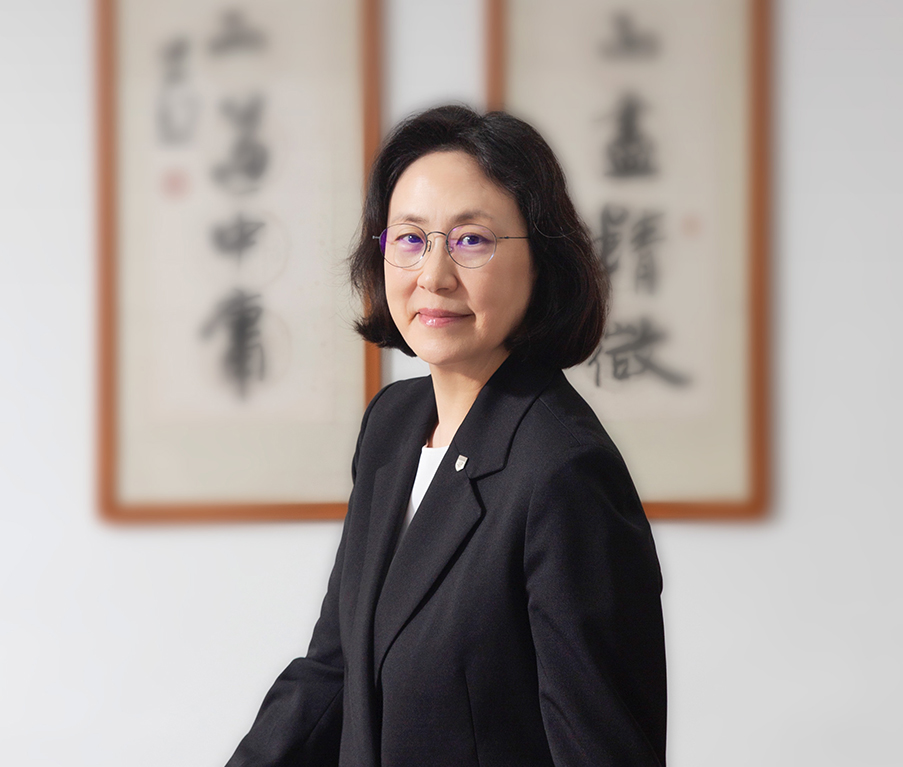
Professor Lee Hikyoung, Dean of the College of Liberal Arts
Department of English Language and Literature, Incoming Class of 1987
A Type of Value
AI Can Never Replace
In the Age of AI, Are the Humanities Facing a Crisis or an Opportunity? What Path Will the Korea University College of Liberal Arts Take?
The emergence of generative AI sent shockwaves across the world, prompting a global scramble to identify jobs that AI might replace. There was even a growing tendency to hastily conclude that the humanities would have no place in the learning of the future. Yet, contrary to these predictions, the international landscape has recently been moving in a very different direction. With global corporations increasingly announcing major investments in the humanities and prestigious universities around the world witnessing a growing influx of talented students into fields such as philosophy and history, the value and presence of the humanities appear to be growing at an accelerating pace. Against this backdrop, we met Professor Lee Hikyoung, the first woman to serve as Dean of the Korea University College of Liberal Arts, an institution regarded as a leading center of humanities education in Korea. Is the age of AI a crisis or an opportunity for the humanities? What vision is the Korea University College of Liberal Arts pursuing as it prepares for this new era?
Q. The rise of generative AI has delivered a fresh shock and sense of fear to society, giving rise in some quarters to concerns about a “crisis in the humanities.” As a humanities scholar and the Dean of the College of Liberal Arts, how do you view the situation today?
I am convinced that now is the perfect opportunity for the humanities to advance further. Until quite recently, there was a widespread perception that majoring in AI-related technologies offered the best prospects for employment. However, reports from the West have increasingly indicated a steady rise in demand for graduates with backgrounds in the humanities. The reason is that, in a period of profound transformation such as the present, society demands the creation of interdisciplinary ideas grounded in humanism that can move beyond existing technological paradigms. The humanities, which explore the fundamental nature of humanity and society, are not an outdated field of study but rather a center of intellectual activity in the emerging era and its new paradigm. The role and value of the humanities will continue to expand in the years ahead.
Q. So the technological revolution driven by AI is actually generating greater interest and investment in the humanities?
AI should be regarded as a partner that all academic disciplines can utilize and develop together. The humanities will play a pivotal role in redefining the human role in the age of AI and in presenting new directions for society by enabling people to continually reflect on how their understanding of humanity is changing amid rapid technological advancement. The world will continue to change after the age of AI, and humanity will encounter a wide range of technological transformations and unprecedented challenges. Yet, because humans will continue to adapt and evolve in response to every historical transition, the humanities, too, will continue to evolve, discovering new meanings and roles within the changing currents of each era.
Q. In the present era, as generative AI can write poetry and respond to philosophical questions, there is a fear that even the uniquely human capacity for thought may be replaced by AI. What, then, is the essential value of the humanities that AI cannot replicate?
The range of domains in which AI can replace human capabilities will undoubtedly continue to expand, but what AI cannot fully embody is “humanity” itself. We must continue to ask the fundamental question, “What does it mean to be human?” and the humanities are precisely the disciplines that seek to answer this question.
While AI can generate outputs that resemble human intellectual capabilities based on vast amounts of data, it is difficult for AI to fully embody genuine human authenticity. This is because authenticity arises from human thought, emotion, experience, and reflection. As a field of study devoted to developing a profound understanding of humanity and exploring the meaning and value of human existence, the humanities not only help us reflect on human dignity and the meaning of life, but also cultivate the capacity to prepare for the future by encouraging us to engage with the present through insights gained from the past. In the age of AI, the concept of human intelligence (HI) emphasized by President Kim Dong-One will become increasingly important. Likewise, the humanities will further consolidate their position as a core discipline that helps define the role of humans and provides direction for humanity amid a rapidly changing society.
Q. Since its founding, Korea University has been widely recognized for its particular strength in the liberal arts. It appears that the university has given considerable thought to the coexistence and advancement of AI and the humanities, as you have described.
Korea University is now articulating a new direction in response to the changes of our time. President Kim Dong-One has declared that the mission of our university is to enhance the intrinsic value of HI—a form of intelligence that AI cannot replace—and to take a leap forward as a “Next Intelligence University” that leads the transition into the AI era. At the heart of HI lies the humanities.
The humanities disciplines, such as literature, history, philosophy, linguistics, and sociology, embodied by the 14 departments within the College of Liberal Arts, explore the fundamental nature of humanity and society, raise essential questions about our society, and contribute to guiding us toward a better future. This is a process of cultivating the uniquely human capacities for reflection and judgment—capacities that are difficult for AI to replace.
Q. As a center of humanities research and education in Korea, the Korea University College of Liberal Arts has an 80-year history and tradition. What changes or new initiatives is the College pursuing in response to the transition into a new era?
The College of Liberal Arts is developing a new model for the humanities for the age of AI. Through initiatives such as the government’s Humanities Utmost Sharing System (HUSS) project, we are striving to cultivate interdisciplinary talent by pursuing educational innovations, such as integrating AI and data technologies into the humanities. What matters is not simply acquiring technological skills, but developing the capacity to explore how humanity and society should define the direction and values that guide technology.
The transformation envisioned by the Korea University College of Liberal Arts is not technology-centered, but human-centered. The more problems AI is able to solve, the more important it becomes for humans to raise meaningful questions and engage in wide-ranging discussions. The society of the future will need people who can contemplate the direction and values of technology based on a deep understanding of humanity and society, rather than merely those who are able to use technology effectively. Building on its distinguished tradition and the integration of contemporary wisdom into our understanding, the Korea University College of Liberal Arts seeks to become a leading center of the humanities that helps envision a society in which humanity and technology coexist. As we prepare for the next century of the humanities on the foundation of our 80-year tradition, we will continue to evolve as a place that cultivates individuals who reflect deeply on the value of humanity and their social responsibilities.

▲ Lee Hikyoung, Dean of the College of Liberal Arts
Q. I understand that there is a course titled “Applied Digital Humanities.” What exactly is digital humanities?
Digital humanities is an interdisciplinary field that integrates digital technologies and tools, including AI and big data, into humanities education and research, thereby expanding the ways in which knowledge is produced and explored. By moving beyond the labor-intensive methods traditionally used to study vast bodies of classical texts and historical sources, digital humanities seeks to employ more efficient and multidimensional methods of research, deepening and broadening our understanding of humanity and society.
Moreover, digital humanities explores sustainable solutions to the diverse challenges facing future societies through innovative thinking and ethical reflection. Even amid rapid technological advancement, the discipline plays an important role in providing direction and answers in light of social changes through the critical and reflective perspectives of the humanities.
The course “Applied Digital Humanities” is designed to enable students to understand and utilize AI and data from a humanities perspective. The more technology advances, the more important it becomes to understand humanity. As it has always been, the College of Liberal Arts will continue to be a place where this fundamental question is explored in the greatest depth.
Q. As a dean, what advice would you like to offer young people majoring in the humanities in an increasingly technology-centered society?
Regardless of what professions and industries emerge in the future, the demand for individuals with a strong grounding in the humanities will continue to grow. As advanced technologies, including AI, continue to develop, it will become increasingly important to understand how technology and humanity can coexist and complement one another, and how people can communicate and live alongside both other people and machines. These are the questions that the humanities, grounded in a deep understanding of and reflection on what it means to be human, are best equipped to address.
As the saying goes, “The only constant is change,” humanity and society have continuously changed and evolved, and will continue to do so. Amid this process of change, the humanities will continue to play an important role as a beacon of truth, illuminating the direction in which humanity and society should move forward.
Q. The College of Liberal Arts is currently undertaking a major fundraising campaign in celebration of its 80th anniversary. What is the College’s mission statement, and why should people invest in the College of Liberal Arts?
Marking its 80th anniversary, the College of Liberal Arts is embarking on a new century under the banner of “Humanities for All.” To provide a driving force for this vision, the College has launched the Future Development Fund campaign.
The humanities serve as a compass that guides us toward the creation of a healthier and happier society. Their influence is not confined to any particular field or social group; rather, the humanities generate knowledge and values that can be developed and shared by all. Therefore, an investment in the Korea University College of Liberal Arts is ultimately an investment in the future of the humanities in Korea—and, by extension, in the future we all share. The College remains committed to actively engaging with society, promoting and sharing the value of the humanities with a broader community, and expanding the intellectual resources that can benefit humanity and society. If you join us on this meaningful and inspiring journey, I am confident that together we can build a brighter future for all.