- writing date 2026.10.13
- author Communication Team
- hits 2
Theme-Contributed Article
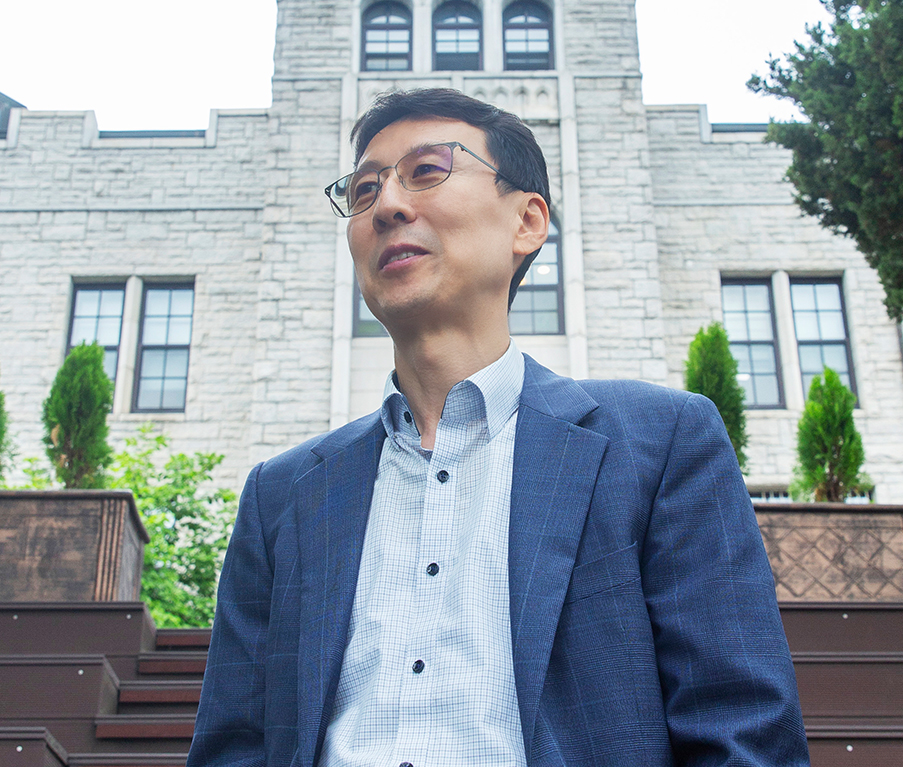
Professor Kwon Youngwoo, Department of Philosophy
Beyond Knowing: Humans Questioning How Knowledge Should Be Used
Humans have long striven to understand both the world and themselves. Academic disciplines are the fruits of this intellectual endeavor. In this sense, scholarship as a whole comprises knowledge of the natural world and of humankind itself. The former includes the natural sciences, while the latter includes the social sciences and humanities. Humanity’s ceaseless intellectual curiosity has expanded the boundaries of knowledge, and this process will continue in the future.
Let us, however, pose the following question: Is the purpose of pursuing knowledge merely to know something? Most people would probably answer that it is not. Those who answer affirmatively might regard the pursuit of knowledge as an end in itself. However, if knowledge ultimately cannot be put to use in some manner, the value and significance of pursuing knowledge may be lost. Even knowledge derived from the pure sciences ultimately often finds application in the real world. The chain connecting theory and practice is often so long and complex that people scarcely recognize it. For example, efforts aimed solely at understanding the motion and properties of electrons ultimately gave rise to technologies used to develop a wide range of electronic devices. Likewise, research into the nature of human beings has permeated social institutions, legal systems, and culture. The purpose of pursuing knowledge cannot be said to lie solely in its practical application. If that were the case, the expansion of knowledge would have come to a halt at its earliest stage. But it continued because the most fundamental basis for the expansion of knowledge lies in pure intellectual curiosity, without any particular application in mind. However, the attitude of the vast majority of people toward knowledge is not only far from the pursuit of knowledge for its own sake; some even go so far as to argue that the pure sciences are of no practical use. The reason is that knowledge derived from the pure sciences does not directly generate any tangible value in the real world. For instance, one cannot manufacture electronic devices simply by studying the most fundamental structures and properties of matter. Likewise, the pursuit of truth does not offer any practical assistance in resolving the various real-world problems facing humanity. Since, in any given era, the vast majority of people do not engage in academic pursuits, it may be natural for them to seek the value of knowledge in its practical applicability.
Knowledge as Power in the Context of Competition
Consequently, knowledge is often regarded as a source of power and a tool for gaining the upper hand in a competition. Francis Bacon’s famous assertion that knowledge is power, made in Novum Organum (The New Organon), carries multiple meanings. Nevertheless, most people would probably understand the power of knowledge as a source of the ability to exercise practical control and dominance. Bacon criticized Aristotle’s logical and deductive approach to scientific inquiry and advocated for the introduction of inductive methods, laying a methodological foundation for modern science. Galileo, meanwhile, became a pioneering figure in modern natural science through experiments that critically tested Aristotle’s natural philosophy. Bacon, Galileo, and Newton, who played foundational roles in the emergence of modern science, may be regarded as marking some of the most brilliant moments in the intellectual history of humanity. This is because modern science served as the foundation for many civilizational achievements that have been made possible by contemporary scientific knowledge.
At every turning point in the development of human civilization, there has been a corresponding leap in technology. Such technological advancements have been achieved through the power of knowledge. As humanity transitioned from the Stone Age to the Bronze Age, and subsequently to the Iron Age, civilizational hegemony shifted toward those who possessed new technologies. This process is still underway today and will likely continue into the future. Human history can be understood as a “process of challenge and response” because, even while seeking lessons from the past and envisioning an ideal future, humans are inevitably compelled to live in a present fraught with competition that threatens their survival. If it means defeating a competitor who poses a threat to their survival and ensuring their continued existence, humans will even repeat past mistakes and abandon the ideals they have envisioned for the future. For this reason, confronting the reality of immediate challenges and responding to them effectively is of paramount importance. Reality is filled with harsh moments in which failure to respond adequately to the challenges at hand leads to extinction. Knowledge is revered as the power that enables humanity to overcome such realities.
The Power of Knowledge: Shaping Markets and Countries
Wisdom cannot be defined as merely possessing knowledge of the object one seeks to know. Rather, wisdom may be understood as a skill that enables the use of knowledge to achieve specific goals. Therefore, knowledge exerts substantive power when it is combined with wisdom. How, then, is the power of knowledge realized? In practical terms, there are broadly two ways in which it is realized. The first is market power, and the second is political power. Some might also identify cultural power as a third form. In reality, however, cultural power is increasingly reduced either to the expansion of cultural industries or to the framework of national competitiveness. In this respect, cultural influence that remains independent of capital and power has, regrettably, become increasingly difficult to find.
Today, knowledge has become the key determinant of the market power of both corporations and countries. The ability to develop new technologies through knowledge, produce superior products, and gain a first-mover advantage over competitors in the market has become critical to strengthening market power. Moreover, the number of a country’s companies leading the global market has become a decisive factor in assessing its national power. It is self-evident that a country’s military power is determined not only by its weapons systems, which increasingly rely on advanced technologies, but also by its economic capacity to acquire and maintain such expensive systems through substantial budgetary investments. At the same time, countries are strengthening their networks of power through technologies that enable them to efficiently control, monitor, allocate, and manage all their resources, including their populations. Consequently, people today celebrate their country’s technological advancements while experiencing anxiety and fear when a rival or adversarial state possesses technologies superior to those of their own.
A New Total War Under the Banner of Artificial Intelligence
People define the present moment as the “age of artificial intelligence.” But can the era in which we live truly be defined by a single concept? In truth, the present era can be characterized by countless different phenomena. Why, then, do people continually seek to define the age in which they live in terms of a single technology or concept? Perhaps the reason is that, in the competition for capital and power, people are compelled to engage in a form of total war. People naturally tend to concentrate their attention on the fields or technologies in which the greatest gains and losses are likely to occur. Undoubtedly, the technology and field currently receiving the greatest attention is artificial intelligence, which is seen as central to responding successfully to the challenges we face today. Failure to do so would make it difficult to survive in today’s fiercely competitive landscape and would leave us overwhelmed by the fear that we will disappear into the margins of history. Today, we cannot and must not remain indifferent to artificial intelligence, to which everyone is devoting their efforts in the competition immediately before us. This is the undeniable reality we face.
Yet, allowing our lives to become absorbed exclusively in a single technology or topic ultimately distorts our understanding of the world and alienates us from our own lives. When power and capital mobilize numerous media and communication outlets to direct public attention toward a particular field or subject, we risk overlooking the significance of the diverse meanings, values, and relationships that shape our lives. Artificial intelligence is undoubtedly an important issue of our time, but it will not remain so forever. Given the enormous amounts of energy consumed by artificial intelligence, we may soon find ourselves speaking of an “age of energy.” When that time comes, people will become fascinated by new energy technologies. Knowledge will continue to be employed to develop new technologies in response to the demands of the emerging era, and, once again, most people will likely regard this as an expression of the power of knowledge and will consider the act of using knowledge to gain competitive advantage as wisdom. Indeed, this undoubtedly demonstrates the power of knowledge and the nature of wisdom.

Knowledge Lights Our Way When It Contributes to Human Progress
However, do we not risk thinking of knowledge and wisdom merely as sources of power for winning and surviving competition in the age of artificial intelligence? Knowledge has contributed to enriching human life, advancing civilization, and enabling people to live together as happily, freely, and equally as possible within that civilization. It is for this reason that learning has long been revered. But what if, in the age of artificial intelligence, human knowledge and wisdom come to be regarded solely as tools and technologies for winning in competition? Artificial intelligence technology would then be perceived merely as the decisive key to overpowering others in the competition for capital and power. In reality, the vast majority of people are little more than spectators, unable to participate in this competition, oscillating between anxiety and fascination. It is conceivable that, ultimately, only a very small number of people may possess the most advanced artificial intelligence technologies and monopolize capital and power, celebrating their victory for having prevailed wisely in the competition of the age through the power of knowledge.
A new era will bring with it new challenges and responses. However, if no one remains after the competition is over, can that competition still have any meaning? In the past, wars resulted in domination for the victor and subjugation and submission for the defeated. Yet, one of the criteria by which we dare to judge the present age as better than the past is that we have prohibited the domination or enslavement of one human being by another—practices that were rooted in the control of the human body. Fortunately, the recognition that no one should arbitrarily restrain another person’s body has become widely established today. However, artificial intelligence technology is evolving into a technology capable of controlling our behavior and thoughts. Although it does not physically restrain the human body, it renders human labor increasingly obsolete. Moreover, human instrumental knowledge appears powerless in the face of artificial intelligence’s capacity and speed for learning from vast amounts of data. Under these circumstances, viewing knowledge merely as a source of power for emerging victorious in competition will lead to destructive consequences—either the self-destruction of humanity or the subjugation of humans to artificial intelligence.
It is historically evident, and clear from the nature and role of knowledge, that knowledge gives rise to technology and that technology constitutes a decisive force for prevailing in the competition for capital and power. Yet universities in this age must remind themselves, more than ever and more than any other institution, that the most powerful knowledge capable of changing the world often stems from an academic passion that remains indifferent to immediate practical concerns. If knowledge is regarded merely as a tool, in the age of artificial intelligence possessing it oneself will no longer seem particularly important. One may instead come to believe that it is sufficient to delegate one’s intelligence to artificial intelligence and simply use its results to achieve whatever objectives one has in mind. This behavior can already be observed everywhere. Moreover, it is becoming increasingly commonplace for people to take pride in how effectively they outsource their intelligence to AI and how skillfully they can use such technologies of intellectual outsourcing. If this trend continues, most people may come to see this intellectual outsourcing as a sign of their wisdom. What may remain among the general public is nothing more than an incompetent form of intellect trapped in self-deception. A very small number of people may come to possess artificial intelligence technologies and vast quantities of big data, thereby monopolizing capital, power, information, and knowledge. Many people may consequently become increasingly de facto subordinated to this small group. Although it is difficult even to contemplate, it is conceivable that, as some people already speculate in almost prophetic terms, humans integrated with artificial intelligence or artificial intelligence itself may emerge as the so-called “post human” or “next human,” while humanity enters a stage of evolutionary extinction.
Human knowledge holds its greatest value when it contributes to human progress. The person who possesses knowledge is the very one who possesses the power and wisdom to bring about beneficial change in the world. This can never change, even in the age of artificial intelligence.

Professor Kwon Youngwoo
Professor Kwon Youngwoo graduated from the Department of Philosophy at Korea University and subsequently studied philosophy at the University of Basel in Switzerland and the University of Tübingen and Heidelberg University in Germany. His co-authored books include The Reception of Western Philosophy and the Possibility of Postcolonial Philosophy and The Return to Hegel in Contemporary Anglo-American Philosophy. His major articles include “A Study on the Relationship between Logic and Metaphysics in Kant and Hegel,” “On the Immanent Problems of Liberalism and Hegel’s Philosophy of Right,” “A Review of the Relationship between Natural Sciences and Metaphysics from the Point of View of Convergence Studies – Is Metaphysics Dead?” and “Is AI a subject that can live together with humans?”