- writing date 2026.03.17
- author Communication Team
- hits 5
Professor Nam Dae-Hyun
and the Electrochemical Catalytic Materials Lab
into an Eco-friendly Resource

As the severity of the climate crisis intensifies, the challenge to find solutions continues. Professor Nam Dae-hyun of the Department of Materials Science and Engineering was named a 2025 Highly Cited Researcher (HCR) for his pioneering research on the electrochemical CO2 reduction reaction (CO2RR), a field recognized as a next-generation technology for achieving carbon neutrality.
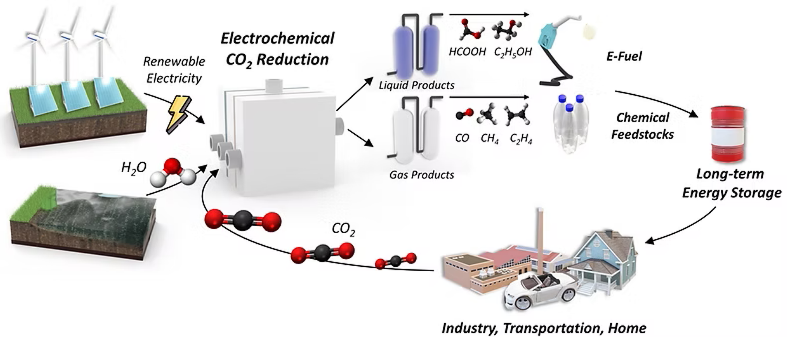
▲ Electrochemical CO2 Reduction Reaction (CO2RR) for Carbon Cycling
Research That Goes Beyond CO2 Reduction to Replace Fossil Fuels
CO2 is the primary culprit behind the climate crisis because it accelerates global warming. While the world continues its all-out battle to reduce CO2, Professor Nam Dae-hyun’s research has attracted significant attention for its imaginative approach. His work focuses on carbon capture and utilization (CCU) technology, which captures CO2 from the atmosphere and converts it into high-value compounds such as methanol, ethylene, and ethanol. Professor Nam specializes in the CO2RR, developing catalytic materials capable of precisely controlling chemical reactions using electrical energy.
“The compounds produced through CO2RR technology are essential to produce items for daily living, like clothing and fuels. Currently, the industry relies on fossil fuels such as coal and oil to create these products, a process that inevitably emits more CO2. Our research aims for a twin effect: reducing CO2 levels while simultaneously providing an alternative to fossil fuels.”
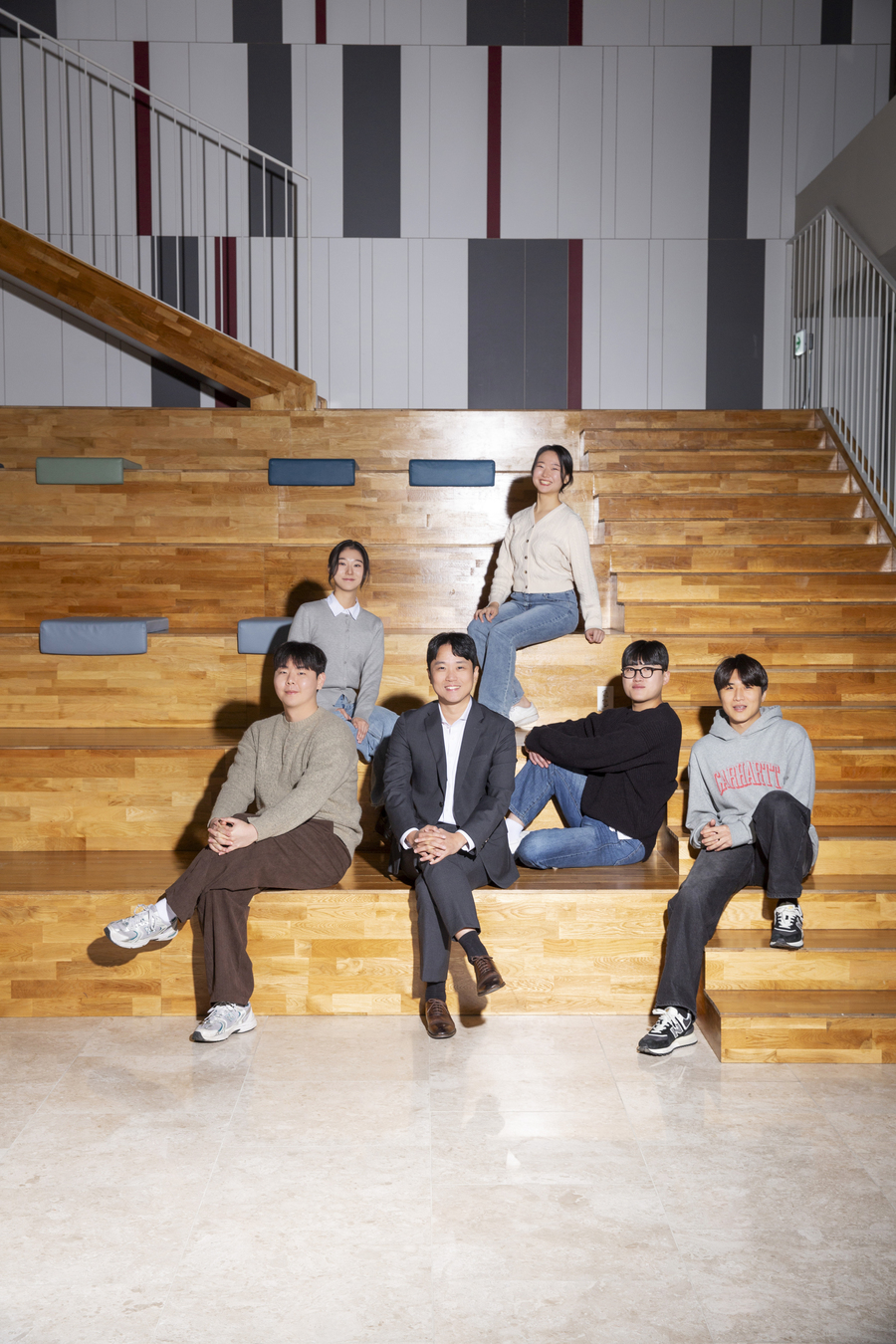
▲ Professor Nam Dae-hyun and other members of the Electrochemical Catalytic Materials Lab
A Path toward Carbon Upcycling
Since the Paris Agreement in 2015 brought carbon neutrality to the forefront of the global agenda, CO2 conversion technology has become a compelling challenge for Professor Nam, who was then studying green hydrogen and electrochemical catalysts. “I have always preferred adventurous research, and I wanted to contribute to the sustainable development of humankind through my expertise in materials science and engineering.” After earning his Ph.D., he devoted himself to this field by joining a research group at the University of Toronto as a postdoctoral researcher, focusing specifically on the CO2RR.
"“With various measures such as carbon taxes and the Carbon Border Adjustment Mechanism (CBAM) being discussed to reduce the use of greenhouse gas-emitting fossil fuels, the development and distribution of renewable energy sources have become a must rather than an option. My lab aims to contribute to the realization of eco-friendly energy and sustainable chemical processes by focusing on CCU technologies linked with renewable energy, and further, carbon upcycling.”
Renewable energy still requires improvements in terms of efficiency and economic viability compared to conventional fossil fuels. To overcome these limitations, active research is underway across various academic disciplines, and interdisciplinary collaboration has become vital.
The Importance of Research Collaboration
“I still vividly remember my first monthly meeting as a postdoctoral researcher. It was truly impressive to see experts from different fields, including materials science, chemical engineering, and mechanical engineering, engaging in heated discussions toward a single goal and advancing research by harnessing their respective strengths.”
This experience at the University of Toronto became the foundation of Professor Nam’s principles for managing his own laboratory. “Research can never be completed alone; it is achieved through collaboration with a diverse range of people.” For this reason, he values a student’s personality as much as their research capabilities. “I want to work with students who prioritize consideration for others and smooth communication over individual greed, seeking to grow together as a team.”
The various lessons he received from his own advisors throughout his career also formed the backbone of these management principles. During his graduate studies, he learned that the most critical element of research is learning “how to think.” During his postdoctoral years, he experienced “the broadening of his research perspective.” Just as he learned from his mentors what creative research is and what attitude and preparation are required to achieve it, one of his primary goals is to provide meaningful mentorship and a supportive research environment for his own students.
Toward a Sustainable Future through Practical Contributions to Carbon Neutrality
While Professor Nam always immerses himself in his work with passion, the research process rarely goes as smoothly as planned. “In those moments, the passion and patience to persevere without giving up are critical. I always emphasize this to my students, so I imagine they must be experiencing a hard time because of me,” he says with a smile. Behind these seemingly strict words lies sincere compassion for his students. “My students have committed their futures to graduate school, and so I truly want them to gain as many lessons and benefits as possible.”
Professor Nam emphasizes that education and research are inseparable. “The research a professor conducts is research conducted together with students. My goal is to establish a laboratory where meaningful research can be sustainably conducted and to be a mentor who guides students in the right way so they can grow into outstanding researchers.” Furthermore, as a researcher, he seeks to develop catalytic materials that can practically contribute to achieving carbon neutrality. His journey is focused on persistently tackling fundamental questions, and it will continue toward a sustainable future.
Kim Geon-woo (DGIST master, class of 24; expected to join as a Ph.D. candidate, class of 2026)
Kim Seong-yeon (integrated master–doctoral degree program, class of 25)
Lee Yu-jin (Ph.D. candidate, class of 25)
Choi Jin-young (undergraduate researcher, expected to join as a master’s candidate, class of 26)
Lee Tae-min (DGIST Ph.D., class of 23, collaborating researcher)
KU LAB DIARY
The Story of Professor Nam Dae-Hyun and the Electrochemical Catalytic Materials Lab
The Electrochemical Catalytic Materials Lab, led by Professor Nam Dae-hyun, is a place where young researchers with a passion for science and the environment gather together. They are achieving things that are almost like magic, including transforming CO2, which is currently being emitted at rates that threaten our planet, into a precious resource for humanity.
Q. What is your life like with your colleagues in the lab?
Yu-jin: There isn’t a big age gap between us, so we all get along with each other like friends. We feel comfortable sharing ideas whenever we hit a wall in our research, and sometimes we lighten the mood with a friendly bet on who buys coffee.
Jin-young: As an undergraduate researcher, I am experiencing lab life with my seniors in graduate school. It has been impressive to experience a horizontal and self-directed culture where everyone takes the time to learn about one another’s research.
Q. What is a typical day like in the lab?
Geon-woo: Usually, I spend the morning organizing data from the previous day and planning the day’s experiments. Then, I make reservations for the necessary equipment and prepare the reagents. In the afternoon, I concentrate on my experiment. Once finished, I try to complete at least the initial data processing on the same day whenever possible.
Tae-min: I maintain a routine of arriving at the lab by 10 a.m. and staying until my work is done. While the schedule can sometimes be demanding and extend late into the night, it’s really rewarding to focus on the data during those quiet hours and see my efforts turn into results.
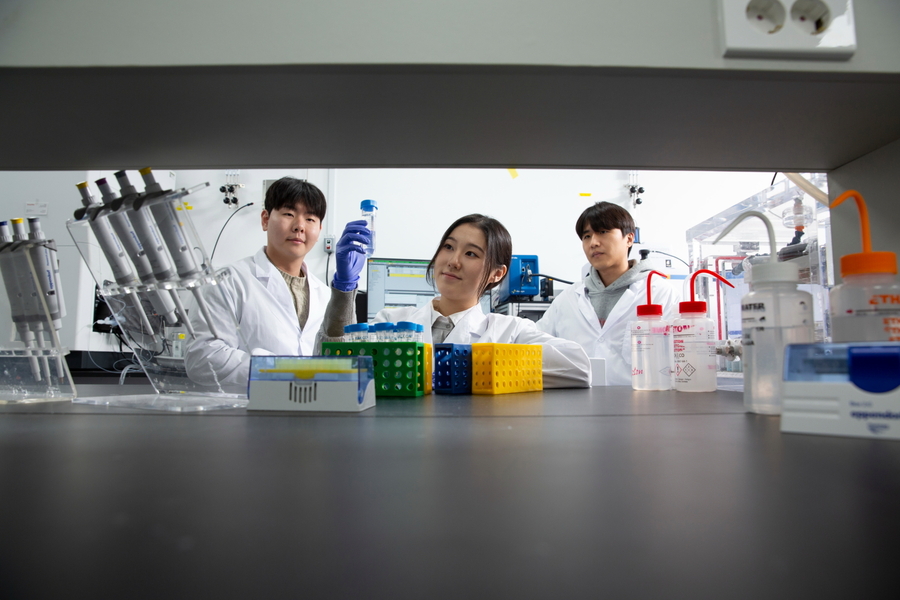
Q. Could you share why you chose this laboratory?
Seong-yeon: Since I was young, I have dreamed of contributing to solving environmental problems. While participating in an undergraduate internship under Professor Nam’s guidance, I found great joy in the process of thinking through problems myself and designing my own experiments.
Geon-woo: It was fascinating that I may be able to study topics that can actually address energy and environmental issues and to verify them through experimental data. The research infrastructure is also excellent. This lab provides a research environment where things don’t just end as ideas; you can complete the entire workflow all in one place, starting from material synthesis to performance evaluation and mechanism analysis.
Q. Are your goals as a researcher also related to the environment?
Yu-jin: I want to be a researcher who practically contributes to solving environmental issues. My goal is to conduct in-depth research, not just synthesizing high-performance electrochemical catalysts, but also deeply reflecting on the various mechanisms occurring within them.
Tae-min: I want to be a researcher who develops innovative technologies that can be commercialized to resolve energy inequalities and address environmental issues.
Q. What have been the most challenging moments during your research?
Seong-yeon: Due to the nature of nanoscale research, experimental results are strongly dependent on even minor environmental shifts, such as subtle differences in the material concentration or humidity. When I receive completely different data from an experiment I thought was performed under exactly the same conditions, I sometimes find myself doubting my own research.
Geon-woo: Exactly right. It is truly difficult when experimental reproducibility fails. There were times when different results were obtained from identical experimental conditions, leading me to track down the cause for several days. I often discovered that the key was ultimately in the basics, like the experimental setup. Since then, I started using a checklist, and I learned a lot from seeing the results stabilize afterward.
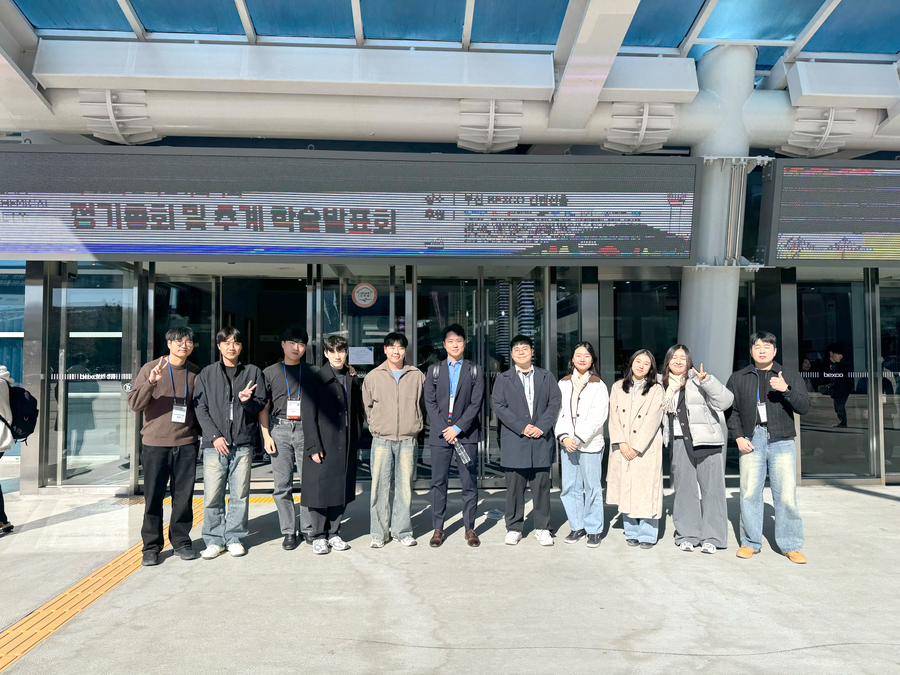
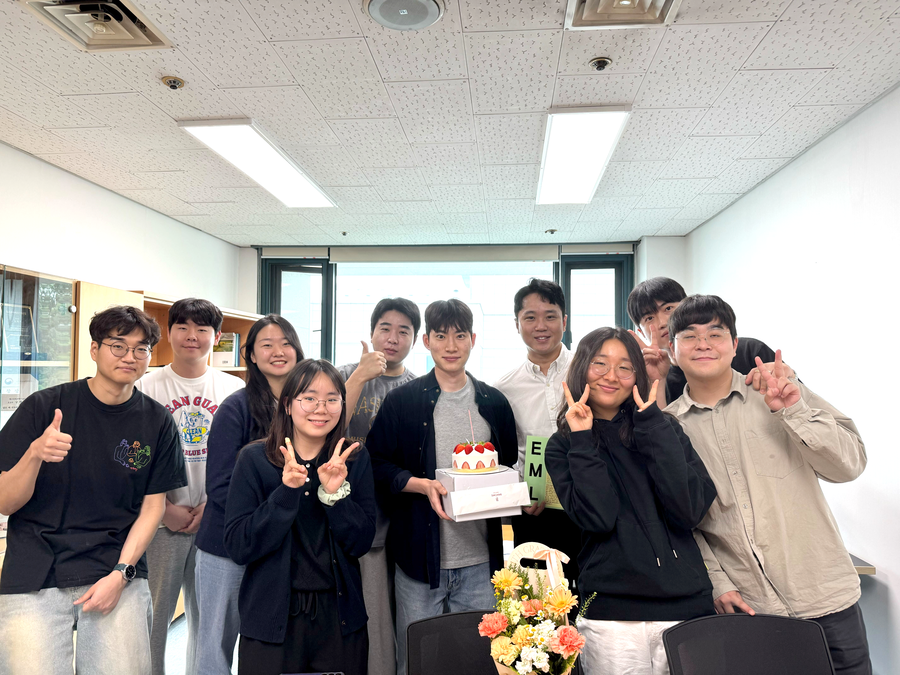
▲ (Top) May 2025, Celebration of Teacher’s Day / (Bottom) November 2025, Fall Conference of the Korean Electrochemical Society
Q. How were you able to overcome those difficult moments?
Seong-yeon: There was a time when the equipment setup for my individual project wasn’t working as planned. I was struggling with it until late at night and let out a sigh without even realizing it. That’s when the senior members stopped their own experiments to look into it with me, generously sharing their experiences and tips. Solving a problem in a few hours that would have taken me days alone made me feel a deep sense of trust in the lab and a sense of belonging.
Jin-young: Since I’m still an undergraduate, I often ask very basic questions. I am so grateful that the seniors never find it bothersome and always answer in a kind way so that I can understand easily.
Yu-jin: I recently experienced burnout. A few things overlapped, and I was struggling emotionally, but my professor sincerely listened to me and tried to find a solution together. Even though it might have been frustrating from his perspective, I was truly moved by how he patiently waited for me to get back on my feet. Thanks to that, I was able to overcome it with the mindset of, “I really want to do well; I shouldn’t give up, and I should try even harder.”
Tae-min: While the professor respects the students’ autonomy, he pinpoints the core of the research with keen insight at crucial moments. I believe he is an excellent mentor who provides the vision and the attitude one needs to have as a researcher.
Q. Any advice for students interested in joining the lab?
Yu-jin: Although our primary research focus is CO2 reduction, we cover a wide range of areas within that field. I believe our greatest strength is the research environment, where we can communicate freely with one another.
Jin-young: I think it would be a good idea to experience the lab first through an internship program, just as I did.
Tae-min: This lab will be the best stage for those who have the passion to keep the lab lights burning late into the night and a positive mindset to learn lessons even from failure. We are waiting for ardent students who want to design the future of energy with us!
Professor Nam’s motto of seeking to work with students who possess “an attitude of growing together based on consideration for others and smooth communication rather than individual greed” was evident in every corner of the laboratory. In particular, his sincere desire to be a “researcher whose research and daily life are inseparable” manifested in small but significant habits, such as using appropriate amounts of reagents and consumables, minimizing unnecessary power consumption, and commuting by bicycle. This is because he believes that upholding the basics, actions that can be practiced immediately, makes their research more meaningful. We look forward to the magical research journey of this team as they transform CO2, which is threatening our planet, into a miraculous resource that can be used to protect the environment