- writing date 2026.03.17
- author Communication Team
- hits 4
by Visiting Professor Song Jee-ye
“What Is Your Korea?”

When you first step into the classroom, multiple languages can be overheard. A greeting in Korean, responses returning in different accents, with shared laughter. Korean Culture in Global Context is a course offered under the Global Korean Studies (GKS) interdisciplinary program for international students seeking to study Korea. Although the course focuses on Korean culture, it does not teach Korean culture as if there were a single correct answer. Instead, students are encouraged to bring their own cultures and experiences to the conversation, placing Korea among them for comparison and re-examination.
"How would you like to be addressed?"
Professor Song Jee-ye begins differently—even with attendance. Because every student in the classroom is an international student, she first confirms each student’s preferred name and pronunciation and makes every effort to address them accordingly. The atmosphere naturally shifts in a classroom composed entirely of foreign students. “Perhaps because everyone is studying abroad, the mood feels more relaxed,” she says. “That helps create an environment where students feel freer to speak.” Although their levels of Korean proficiency vary, that very difference reduces pressure. Namuunjargal, a student from Mongolia, cites this as one of the course’s greatest strengths. “My Korean is not very strong, but since I’m taking the class with other international students, I feel more at ease. I can express my opinions more freely.” Sharing the common identity of being “foreigners” transforms the classroom into a safe space for questions.
Learning Korean Culture, Gaining Pride in One’s Own
For Professor Song, the most rewarding aspect of the course appears in an unexpected place. “Rather than students simply gaining a better understanding of Korea, I find it most meaningful when they develop pride in their own cultures.” The questions posed to understand Korean culture ultimately redirect students’ attention back to their own histories and traditions. Namuunjargal (Psychology, 2023, Mongolia) shared that, while learning about Korean relational culture, she came to recognize new dimensions of her own upbringing. “In Korea, there’s what people call ‘nunchi culture’—being sensitive to others’ unspoken cues. In Mongolia, that culture hardly exists. People tend to express their opinions directly, without worrying about others’ reactions.” While trying to understand Korean communication styles, she found herself seeing more clearly the openness and directness of Mongolian culture. Comparison using Korea as a reference point became a pathway to deeper self-understanding and cultural pride.
Professor Song’s own academic journey also began with comparison. After majoring in Korean history, she pursued international politics. “I chose international politics to better understand Korean history. Comparison helps you better understand your own culture and history.” That perspective naturally permeates the course. Vu Thi Toi, an exchange student from Vietnam, describes how the class shifted her perspective. “I learned to view culture through an anthropological lens. When you look at a culture not in isolation but in comparison with others, you begin to see both its strengths and its limitations. I feel like I’ve practiced looking at cultures without prejudice.” Thus, a class about Korean culture becomes a training ground for how to approach diverse cultures more broadly.

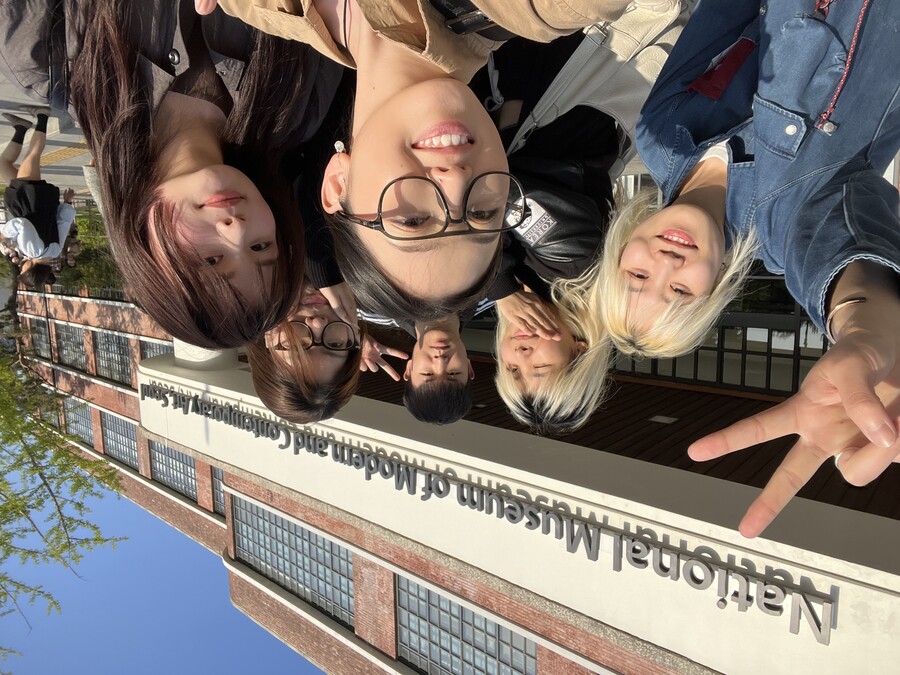

▲ In each class, students visit major sites in Seoul for their group projects (from left): the Seoul Museum of Art team, the National Museum of Modern and Contemporary Art team, and the Jongmyo Shrine team.
Korea Becomes More Three-Dimensional Beyond the Classroom
Korean Culture in Global Context does not remain confined to lectures. Students venture into the city. Working in teams, they visit specific sites and connect those experiences to research and presentations. Field destinations range from Deoksugung Palace and Namsangol Hanok Village to the Seoul Museum of Art and the Seoul Museum of Photography. One student’s presentation often inspires another to think, “I want to visit that place next.” Korean culture and space are refracted through each student’s perspective and language, becoming layered and multidimensional.
For many, the course serves not only as a deeper study of Korea but also as a practical guide for navigating life in the country. “I would recommend this class to friends who have just arrived in Korea,” Namuunjargal says. “It’s a course where you can experience the places you really should visit.” Vu Thi Toi adds, “For exchange students, it’s a chance to explore cultural sites in Korea, give presentations, and build teamwork with other international students.”
Professor Song does not describe herself as a teacher who has all the answers. “With topics like K-pop, students often know much more than I do. Sometimes I wonder whether I’m the one who should be teaching it.” She explains that she often finds herself learning while teaching. Her role is not to explain why popular Korean culture is appealing, but to encourage students to think about how this culture emerged and what it reveals about Korean identity. “Rather than explaining why K-pop is excellent, I try to focus on the context in which it emerged.”
This approach renders the “obvious” unfamiliar. “When you ask about Korean identity, you cannot avoid mentioning the Dangun myth or Confucian culture. But the students in this class do not know these references. The challenge is how to present what feels natural to those raised in Korea in a way that is accessible.” For subjects that are difficult to explain in words—such as funeral rites or everyday customs—visual media becomes the key to opening dialogue. She shows documentaries and archival footage and asks, “How is it in Mongolia?”, “What about Vietnam?” Students respond by offering similarities and differences. At the foundation of the course lies a simple but powerful idea: culture is best understood through comparison and questioning.
Course Syllabus
| Lecture 1 I. Perspectives from Cultural Anthropology |
| Lecture 2 Korean Indentity |
| Lecture 3 Hangeul and Literature |
| Lecture 4 Documentary and Archival Culture |
| Lecture 5 Korean Architecture |
| Lecture 6 Korea Through the Eyes of Others |
| Lecture 7 II. Perspectives from Folklore: Popular Culture |
| Lecture 8 Seasonal Customs in Korea |
| Lecture 9 Rites of Passge: Birth, Marriage, Funeral, and Ancestral Rituals |
| Lecture 10 Indigenous Beliefs and Religions in Korea |
| Lecture 11 III. Perspectives from Cultural Studies: Globalization and K-Culture |
| Lecture 12 Korea’s Cultural Industries |
| Lecture 13 The Korean Fashion Industry and K-Beauty |
| Lecture 14 Korean Food and Food Culture |
| Lecture 15 Final Paper Submission |
A Classroom Where Questions Begin
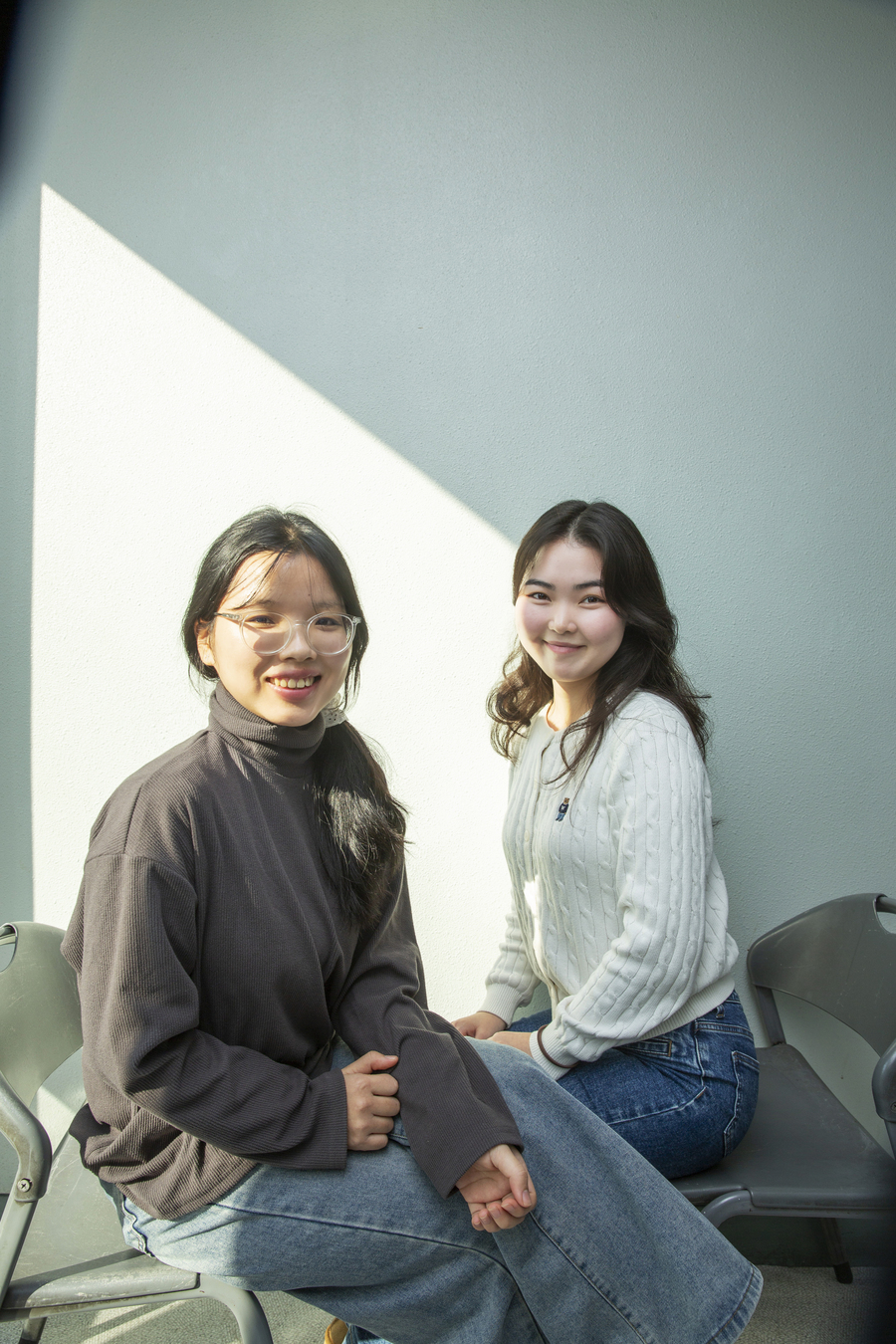
▲ (From left) Vu Thi Toi (Vietnam), Namuunjargal (Mongolia)
The class does not end with understanding; it leads to new forms of curiosity. Namuunjargal shared, “I’ve become more interested in learning Korean itself. In Korea, people use the word uri (‘we’ or ‘our’) very often. In Mongolia, we also use ‘we,’ but we don’t say ‘our country’ in the same way. I want to understand e-x-p-r-e-s-s-i-o-ns like that more deeply, as well as concepts like nunchi.” Vu Thi Toi mentioned that, after watching the recent drama Jeongnyeon, she became interested in traditional Korean performing arts such as gukgeuk and pansori. A class about Korea had sparked a desire to explore Korea more deeply. In this classroom, Korea does not exist in isolation. Only when reflected through one another’s stories does Korea become three-dimensional. For that reason, the title Korean Culture in Global Context refers not merely to the subject matter but to the method of the class itself: placing Korea within the world, and placing the world alongside Korea. In doing so, each culture’s uniqueness comes into clearer focus, and a deeper sense of mutual respect begins to grow.