- writing date 2026.03.17
- author Communication Team
- hits 8
Erasmus University Medical Center
Professor Jung Ji-won
(School of Art and Design 2011)
Through Design and Engineering

She entered Korea University’s School of Art and Design, double-majored at Korea University Business School, earned a Ph.D. in industrial design engineering after graduation, and is now a professor at one of the world’s leading engineering universities while conducting healthcare systems research at the top research-focused hospital in the Netherlands. At first glance, her career may appear to cover entirely different fields. In reality, it is a series of brilliant beads threaded together by a single idea: analyzing and solving social problems through technology grounded in design thinking. We met Professor Jung Ji-won, who teaches and researches industrial design engineering at TU Delft, one of Europe’s premier engineering institutions.

▲ Korea University graduation photo
A Freshman Who Dreamed of Becoming a Car Designer
In 2011, she entered Korea University’s School of Art and Design with the dream of becoming an automobile designer. It was a long-cherished aspiration influenced by her father, who worked as an automotive researcher. “I wanted to become an outstanding car designer. But when I came to the School of Art and Design, I realized there were so many truly gifted classmates. I also learned that automotive design is one of the fields where the most exceptional design prodigies gather. Working alongside peers with an entirely different level of aesthetic sensibility, I began to understand that exterior car design—the dream I had held onto—might not be what I was best at. I had entered university with that goal, so when I realized it might not be the right fit, I found myself wondering what I should pursue instead.”
Although she initially felt disappointed, she quickly moved on to the next question: What, then, am I good at? “Studying business expanded my thinking. Since I had a background in design, I realized I could develop strengths in strategy or design methodology. I thought that, even if I was not the one designing the cars, I could contribute to those who do. I also genuinely enjoyed my business courses.”
Balancing a double major demanded relentless effort. “In design, projects that continue throughout the semester are far more important than midterms or finals. In business, it is the opposite—midterms and finals carry significant weight. So during the semester, I stayed up all night working on design projects and, during exam periods, I devoted myself entirely to studying. I often studied in the law school library. It was the quietest place on campus, and everyone there studied with incredible concentration.”
Adding Wings to Business and Design Engineering
As she contemplated her career path, drawing on the design foundation she had built at the School of Art and Design and the strategic thinking she had developed through her studies at Korea University Business School, the university’s wide range of career-related lectures proved immensely helpful. “One of the things I am most grateful for about my time at Korea University is that the school showed us so many different paths for choosing our future. Alumni frequently returned to give talks about their careers. There were lectures on professions and career development, as well as sessions where we could have open conversations with seniors. I made a point of attending as many as possible, listening carefully, and engaging in discussions. It helped me tremendously. The stories our seniors shared were fascinating and inspiring.”
She went on to earn her master’s degree at KAIST and her Ph.D. at Delft University of Technology, continuing her journey in what was then a relatively new field: design engineering.
“Even if I could not be certain that I was born with perfect aesthetic sensibility as a designer, I was convinced that design could have a meaningful social impact.Alongside design thinking and strategic reasoning, I learned computer programming languages such as Python during her master’s program. During this process, I began asking how design methodologies could be integrated with computer engineering and data science. “At that time, I heard that TU Delft and the global company Philips were exploring the same questions and were building design methodologies grounded in data engineering. When I learned about that project, I decided to apply for my doctoral studies in the Netherlands.” She conducted research in Delft, home to TU Delft, and in Eindhoven, where Philips is headquartered, confronting real-world challenges firsthand and working toward practical solutions. TU Delft’s approach—analyzing and addressing social problems through design—aligned precisely with her own philosophy. “At Delft, design is not defined as something innate, but as something that can be taught and learned. Rather than focusing primarily on aesthetic sensibility, the emphasis is placed on design thinking. I found that philosophy deeply compelling. There is also a greater focus on how technology contributes to society and solves social problems, rather than on rapid technological advancement alone.”
TU Delft and Professor Jung’s Mission to Solve Social Problems Mission
“How can children with heart disease exercise freely?”
Children with heart conditions often struggle to engage in sufficient physical activity due to health concerns. Yet appropriate exercise is not only necessary but beneficial. How can we help these children move safely and confidently?
“Why do children with heart conditions so often end up as the goalkeeper?”
Through research, Professor Jung’s team discovered that the primary reason children with heart disease avoid physical activity is not necessarily their actual medical condition, but the concerns and fears of their families. Parents often, even unconsciously, send the message: “Move as little as possible.” If this fear could be reduced, and safe exercise made possible, what might change?
Professor Jung’s research team is developing and studying a wearable-device-based system designed to track children’s heart health indicators, such as their heart rate, in real time. The system delivers user-friendly notifications to both children and caregivers regarding changes in heart rhythm and early-stage risk signals, while also enabling smooth communication between caregivers and medical professionals without placing excessive burden on healthcare staff. The goal of this research is to alleviate what may be an even greater barrier than the illness itself: parental fear. By reducing that fear, the team aims to create an environment in which children can exercise with confidence and peace of mind.
Technology and Innovative Design for Solving Social Problems
One of the key courses Professor Jung teaches is Tech-enabled Innovation Studio. “In this course, the Dutch government or companies act as clients and commission designs to address real societal problems. Over the course of a semester, students and I work together on these. For example, the Dutch Ministry of Economic Affairs might request a digital innovation strategy to prevent tax evasion. Rabobank, which is comparable to an agricultural cooperative bank, might ask us to design a system that effectively educates farmers about the European sustainability score. If a farm produces excessive CO₂ emissions while raising cattle, it may not qualify for certain loans.”
Although AI technology is employed to address these issues, AI itself is not the ultimate goal. The primary objective of the course is to explore how the process and methodology of deriving solutions can be innovatively designed and developed using AI tools.
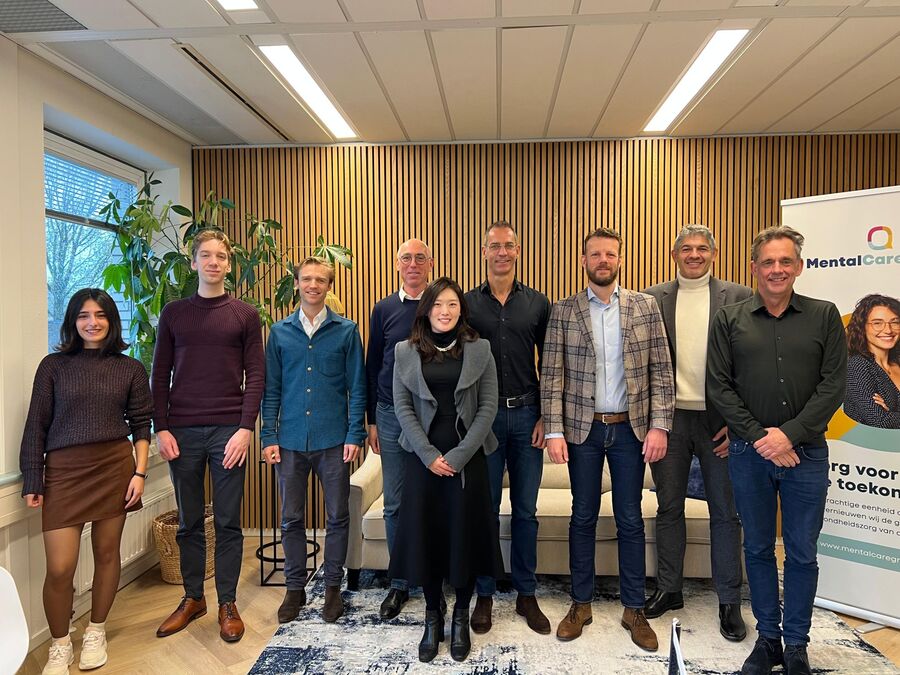
▲ CO-AI Health, a KRW 700 million mental health AI research project led by Professor Jung as principal investigator
Professor Jung also holds a joint appointment in the Department of Surgery at Erasmus Medical Center, the largest research-focused hospital in the Netherlands. She is currently leading projects on AI-based healthcare system transformation and “Future Clinic 2030.” These initiatives are part of the Dutch government’s “Data-driven Innovation and Healthcare Acceleration” program. Within just two years of her appointment, she and her research team secured approximately KRW 3.5 billion in research funding—an achievement of significant impact. “The current Dutch healthcare system can only be sustained if more than one-sixth of the population works in the healthcare sector, and that proportion is expected to rise. We are using AI to improve the system so that high-quality services can be delivered without continually increasing the workforce. Our goal is to innovate the entire system.”
A Designer Who Discovers and Solves Society’s Hidden Needs
As a researcher, what is Professor Jung Ji-won’s vision? “I often describe it as ‘Society as Lab.’ I believe researchers need tools or methodologies that allow them to deeply understand what society is truly asking for. Identifying users’ latent needs is also the role of a designer. We must first uncover the hidden needs within society and then develop technology based on those needs. Rather than observing society only from within the laboratory, I want to continue exploring how we can step beyond the lab and truly examine society itself.”
If engineering is the discipline that seeks optimal solutions to given problems, Professor Jung explains that design requires discovering the problem and designing the solution simultaneously. Closely examining systems and creating systemic change, influencing policy, and ultimately driving social transformation are all powers of design thinking. Her goal is for research not to remain confined to academic papers or presentations, but to influence real-world society and policy, generating tangible change. Her journey of identifying and solving social problems is one to watch.

.jpg "Most Inspiring 수업 수상")
▲ Receiving the “Top 3 Most Inspiring Class” award selected by students
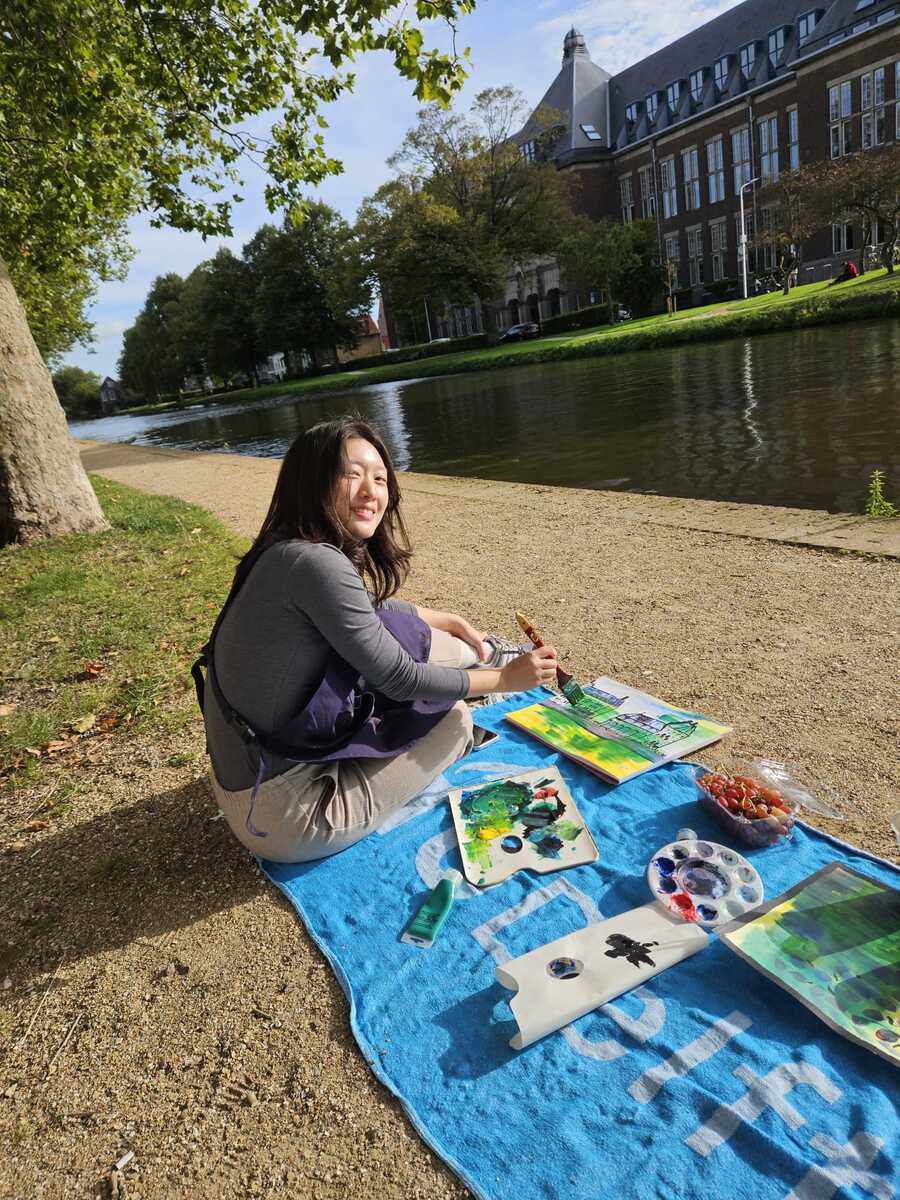
▲ Sketching with friends by the Delft canal, the city that was the home of Vermeer (the painter of Girl with a Pearl Earring)
Special Page | A Letter from the Netherlands to Korea University’s Students
Hello, Tigers of Anam. I am currently teaching students at TU Delft in the Netherlands. Through Korea University Today, I was invited to share a message with students on campus, and I am grateful for this opportunity.
The confidence to choose my own path anywhere in the world stems from my experiences as an undergraduate at Korea University. In my early twenties, when I was uncertain about what kind of future to dream of, the various opportunities provided by the university allowed me to engage in conversations with seniors, peers, and juniors. Through those interactions, I encountered broader and more diverse perspectives. It was during that time that I began to concretely envision what kind of life I could lead and what direction my career might take.
While you are in university, such experiences may feel ordinary. However, after completing my master’s, doctoral, and postdoctoral training in environments centered primarily on engineering and medicine rather than comprehensive universities, I came to realize how valuable it was to be part of a university where people with different academic disciplines and life paths naturally coexist. Simply having “examples” of people pursuing different dreams in your everyday environment expands your sense of possibility. For that reason, I believe one of the greatest assets for Korea University students is connection—connection with people of different majors and different ways of thinking. During my undergraduate years, I learned how to build meaningful relationships and how to strengthen them through dialogue and trust. As time has passed since graduation, I have watched classmates, seniors, and juniors walk their own paths in industry, academia, and government. They remain people with whom I can seriously discuss what kinds of lives are possible and what kind of life feels most authentically mine.
To all of you at Korea University, I offer this: during your time at university, cross the boundaries of majors and interests. Meet many people. Ask many questions. Have many conversations. Rather than chasing a single “correct” career answer, take the time to ask yourself what kind of life you want to live. Within and beyond those questions, I sincerely hope you will carve out your own way of contributing to society in your own way.
From TU Delft, Jung Ji-won