- writing date 2026.03.17
- author Communication Team
- hits 9
Professor, Department of Physics, KU
Director, Center for Cold Quantum Reactions

Human Instinct in Search of an Uncharted Realm
The essence of science is ultimately exploring uncharted realms. Understanding phenomena that have yet to be elucidated and integrating them into an explainable order—this is the process of expanding human knowledge.
In physics, “uncharted” does not simply mean a state of not knowing; it refers to the structures of the world that make up the reality we live in but have not yet been fully described in our language. To explore and understand the uncharted realms behind our world and to make the world a better place based on that understanding—this is the essence of research, something I engage in every day.
Quantum Science and Technology, at the Threshold of a New Order
I am studying quantum computing, quantum simulation, and quantum chemical reactions using molecules cooled to temperatures near absolute zero. When molecules are cooled to ultralow temperatures, thermal fluctuations almost vanish, and the internal states of the molecules become precisely distinguishable through quantum mechanics. In this state, the quantum state of individual molecules can be finely controlled using lasers or microwaves. Utilizing this control for computation is known as quantum computing, while exploring how changes in quantum states affect chemical reactions is the study of quantum chemical reactions.
“However, despite the contrasting goals of these fields, their essence remains the same; they are attempts to handle the purest quantum states permitted by nature, interpreting and utilizing the fundamental order of the physical world within them.”
Quantum computing has received significant attention recently. Quantum computers are capable of performing calculations that are difficult for conventional computers to achieve by utilizing superposition and entanglement, which are the most mysterious phenomena in quantum mechanics.
Quantum superposition refers to a phenomenon where a system can exist in multiple states simultaneously. For example, while a bit in a conventional computer stores and processes information as either 0 or 1, a quantum bit (qubit) in a quantum computer can be both 0 and 1 at the same time. However, this state does not represent an intermediate value like 0.5. When the value of a qubit in superposition is measured, it is always observed as either 0 or 1.
By utilizing the quantum superposition of qubits to process multiple computational states simultaneously, a quantum computer can handle problems in a single parallel operation, while a classical computer would be required to calculate every case one by one. As the number of qubits increases, this parallelism grows exponentially, demonstrating computational power far superior to the linear parallel processing of classical computers or GPUs.
Quantum entanglement is a phenomenon where two or more quantum systems are so strongly connected that the state of one instantly determines the state of the other. In other words, each system cannot be described independently; they exist as a single integrated unit. For example, if A is 0, B must be 0, and if A is 1, B must be 1. While each bit in a classical computer operates independently, qubits in a quantum computer can control multiple qubits simultaneously through a single operation via entanglement, thus dramatically improving computational efficiency.
Quantum computing is advancing rapidly at present, creating waves of innovation across society, including science, industry, telecommunications, and artificial intelligence. Before long, we will witness the birth of a new order, the “Quantum Information Age”.

Publication <The First Encounter of the Quantum World>(2025, BookPleasure)
Turning Uncharted Realms into Reality: Efforts to Construct a Universal Quantum Computer
There is no doubt that quantum computers have the potential to change the world, yet a long journey remains until the completion of a universal quantum computer. Currently, the number of qubits in quantum computers being developed by major research groups and companies worldwide is generally within the range of dozens to a few thousand. Notably, IBM presented a processor with more than 1,000 qubits in 2023, and Google performed experimental calculations on a scale of about 100 qubits with its Willow chip in 2024. A 6,000-qubit system has also been unveiled in neutral atom systems. However, it is estimated that tens of thousands to millions of physical qubits are required to suppress errors and perform full quantum error correction. In other words, the current level of this technology is not yet at the stage of computation but rather in the experimental stage of scaling.
Increasing the number of qubits is not merely a matter of expanding the system. As the number of qubits increases, complex issues such as controlling quantum entanglement, removing noise, preventing decoherence, and achieving precise synchronization become more complicated. Unlike classical computers, which have evolved by integrating independent transistors, entanglement between qubits in a quantum computer leads to physical interference, and the entire system operates as a single, massive quantum state. For this reason, succeeding in stabilizing one qubit does not immediately translate into the stable control of hundreds.
Quantum error correction makes the problem more difficult. Qubits are easily affected by even minute external factors such as heat, vibration, and electromagnetic noise, causing their states to collapse. This is why dozens to several thousands of physical qubits must be bundled to create a single logical qubit. To realize a universal quantum computer equipped with full error correction capabilities, we need qubit control technology on a scale several orders of magnitude larger than the current one.
While numerous issues remain to be resolved in order to realize a universal quantum computer, what is significant is that our technology is making steady and certain progress. Over the past decade, advancement has been made at a pace that has surprised even me as a researcher and, during this process, we have gained a deeper understanding of the operating principles of quantum systems. Ultimately, our journey toward a universal quantum computer goes beyond simple technological development; it is an experiment testing the degree to which humans can understand and control a nature filled with uncertainty and noise, and it is the relentless effort to turn an unchartered realm into reality.
A Whole New World Transformed by Quantum Computing—On the Boundary between Technology and Responsibility
I often envision a world where quantum computing has been commercialized. That world might not simply be a faster and more efficient society. Quantum computers are undoubtedly tools with immense potential. They can trigger revolutionary changes in problem domains that classical algorithms cannot handle, such as the simulation of complex molecular structures, optimization problems, and cryptography. At the same time, however, there is a possibility that this computational power could neutralize secret communication networks or drastically widen the technological gap between nations in specific industries. As such, we will be required to make ethical choices and assume a far higher level of responsibility than before.
“Technology is inherently neutral. Whether it becomes a force for good or evil depends on the choices of the users and the direction of our institutions.”
In the face of uncertain potential, the role of a scientist must not be limited to that of a mere technician or discoverer. It must be accompanied by the responsibility of predicting the social impact and ethical boundaries of technology. During the research process, scientists must constantly ask: “How far should this technology be extended?” and “Who will control and have access to this computational power?” For scientific progress to improve the knowledge and welfare of all of humanity, the decision-making structures surrounding the technology may be more important than the technology itself.
Researching quantum computers is, ultimately, a process of experimentally verifying realms of computability that humans do not yet fully understand. By repeatedly integrating experiments and theories, we will gradually come to more fully grasp the limits and structures of information processing permitted by nature. However, reaching a complete understanding of quantum systems may be realistically impossible. Instead, we continue to accumulate the experience of reaching higher levels of predictability and controllability while reducing uncertainty. This cumulative process is itself an act of scientifically exploring an uncharted realm, and it may be the ultimate significance of quantum science.
Interview
Walking the Road Not Taken in Search of Rarity
Interview with Professor Chae Eun-mi, Department of Physics
The female student who ranked first in the natural sciences track of the 2002 College Scholastic Ability Test (CSAT) chose to study in Japan instead of entering a university in Korea. After enrolling at the University of Tokyo in 2003, she made headlines four years later at the graduation ceremony by becoming the first Korean to receive the President’s Award, the highest honor for the top student at the university. Now, 20 years later, Professor Chae Eun-mi, having completed her master’s at the University of Tokyo and her doctorate at Harvard University, is immersed in her research, serving as a professor in the Department of Physics at KU and the director of the Center for Cold Quantum Reactions, run by the Ministry of Science and ICT.
Q. This is your second time meeting with
- That’s right. I was featured in an interview with my children for an article about the KU workplace daycare center in the autumn issue last year. I’d like to express my gratitude once again to the daycare center because it is a tremendous help for my research life (laughs).
Q. It was a long time ago, but your decision to study in Japan after ranking first in the natural sciences track on the CSAT became a huge topic of conversation. I’m curious about the reason behind that choice.
- During my senior year of high school, I happened to see a notice on the bulletin board at the back of the classroom recruiting students for a Korea–Japan joint government scholarship program for undergraduate science and engineering majors. I applied without much thought, simply hoping to reduce the burden of the CSAT, and thankfully, I was accepted. When the CSAT results came out and I had to make a final decision, I agonized over it. I had so many questions: Is it really a good idea to study abroad at such a young age? Can I survive on my own? Wouldn’t it be more advantageous for my future career and networking to complete my undergraduate studies in Korea? What came to my mind at that time was that, if I chose a career in science and engineering, I would eventually go abroad anyway, whether for graduate school or postdoctoral research. I thought, “Why not go earlier and gain more experience?” I also thought that taking the road not taken by others might increase my “rarity” as an individual. That’s why I chose to pursue my undergraduate studies in Japan.
Q. How was your life as an international student at the University of Tokyo and Harvard University?
- At the University of Tokyo, there were students who were absolute “physics geeks” and dedicated everything to the subject (laughs). At first, looking at them, I thought, “I like physics, but I don’t think I can love it as much as they do, so I probably won’t be able to keep studying it.” Then, thankfully, receiving the President’s Award gave me the courage to think, “Maybe I should try a little bit more?” However, in Japan, the master’s and doctoral programs take five years, and I was terrified of the idea of holding a Ph.D. title in just five years. I felt I was still very lacking. So, I decided to test myself once more and challenged myself to study in the U.S., which led me to Harvard. In a way, my journey has been a series of challenges to overcome my own lack of confidence, and I’m still on that journey.
Q: What motivated you to specialize in quantum mechanics among the various fields of physics?
To be honest, it was my fascination with lasers that first drew me in. I remember seeing a lab filled with lasers of various colors glowing beautifully, and I thought to myself, “Now, this is an experiment I could truly enjoy!” That’s how I chose my lab for my undergraduate research. Later, I learned that the lab was conducting core research in quantum mechanics. I found the field so interesting that I’ve been pursuing quantum research ever since. The most important step in understanding quantum mechanics is simply lowering your mental barriers. Many people immediately think it’s too difficult or that it has nothing to do with them, but when you set aside the complex mathematics, quantum mechanics is full of fascinating features. While some concepts may be in conflict with our intuition, when you keep an open mind and think, “So that’s how it works!”, it becomes an incredibly fascinating field of study.
Q: You’ve published your first book, “The First Encounter of the Quantum World,” and you continue to communicate with the public through lectures and YouTube. What has that experience been like?
I’ve learned that so many people are genuinely curious about quantum mechanics and quantum technology, but they still find the subject too difficult to understand. Although there are many introductory books out there, I received frequent requests for a guidebook that explains these concepts clearly without relying on complex mathematical equations. While many books cover the fascinating history (actually, there are many intriguing stories) and core concepts of quantum mechanics, few bridge the gap between those concepts and the way they are applied to current or future technologies. That’s why I decided to write a book, one that is virtually free of mathematical formulas, to serve as a truly accessible guide to both quantum science and technology. Honestly, everything involved in publishing and promoting this book has been a series of new experiences for me. However, it’s incredibly rewarding when people tell me, “I think I’m actually starting to understand it!” Interestingly, explaining quantum mechanics without math also helped me strengthen my own understanding. (To be fair, for researchers in science and engineering, explaining things through math is actually the easiest way!)
Q: What specific field of quantum mechanics do you study, and what impact will it have on humankind?
Since my undergraduate years, my research has focused on the experimental implementation of various quantum phenomena. In Japan, I worked on implementing Bose-Einstein Condensation (BEC), which is a representative quantum phenomenon that earned the Nobel Prize in 2001, within solid-state systems. At Harvard, I conducted research on cooling molecules to absolute zero using lasers to achieve quantum-level control. What is really fascinating is that I utilize equipment that I built with my own hands to cool invisible atoms or molecules to absolute zero and manipulate their quantum states as I wish. With the advancement of these technologies, we will be able to realize molecular qubits, which can be applied to fields like quantum computing and quantum sensing. Recently, the precision and scale of qubit control across various systems, such as superconducting qubits, atoms, ions, and photons, have been advancing at a breathtaking pace. Even as a researcher in the field, I find this progress truly awe-inspiring.
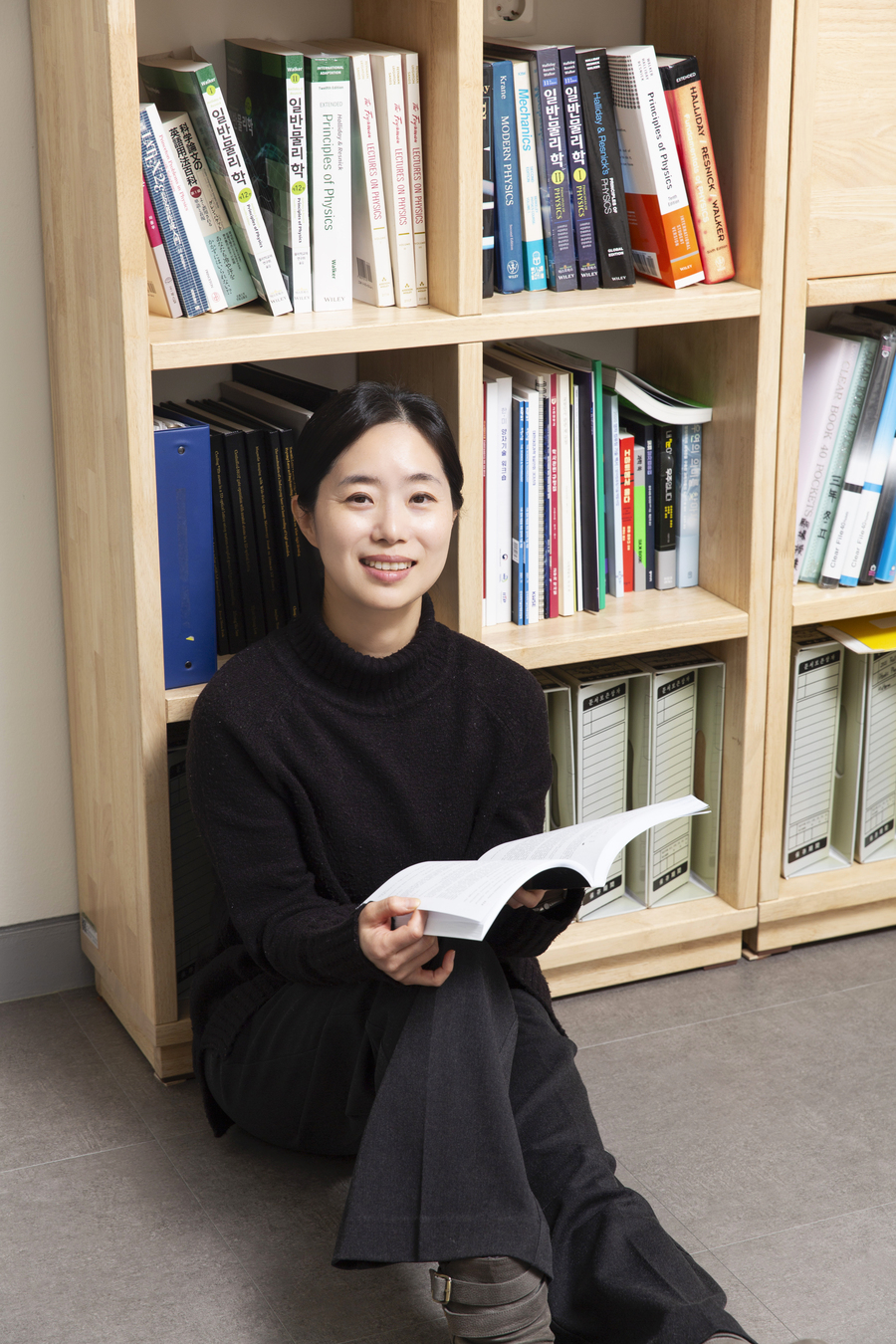
Q: As a professor in the Department of Physics at KU, how would you describe the “world of KU students”?
I started my position as a professor in March 2020, right at the beginning of the COVID-19 pandemic, so I couldn’t meet my students in person for quite a while. I still vividly remember the joy I felt when the pandemic finally eased and I saw students gathered in small groups on the lawn in front of the Asan Science Building. Our KU students are the best ones, even when compared to those at top-tier universities in Japan or the United States. Whether it’s the undergraduates in my lectures or the graduate students in my lab, they are all incredibly brilliant, full of great ideas, and possess an excellent sense for experiments. They are truly better than me back when I was an undergraduate! I have high expectations for them to develop into outstanding researchers. Also, seeing the massive wave of students lined up at Hwajung Gymnasium for cheering practice was a deeply moving sight.
Q: The theme of this issue of
Looking back, my life has been a journey of pursuing scarcity. Whenever I stood at a crossroads, I chose the path that others rarely took but that truly attracted me. Eventually, those choices formed my unique background and became the source of my strongest competitiveness. You will all face your own moments of choice. If you are hesitating to pursue something you truly want just because it’s a path less traveled, I encourage you to boldly take up the challenge. That choice will eventually become your own unique strength.
Professor Chae Eun-mi, Department of Physics, KU
Chae Eun-mi is a Professor in the Department of Physics at Korea University. She earned her undergraduate degree in Applied Physics from the University of Tokyo and received her Ph.D. in Physics from Harvard University. After serving as an Assistant Professor at the University of Tokyo, she joined the faculty of KU in 2020. Her research focuses on experimental atomic, molecular, and optical (AMO) physics and quantum information science. Professor Chae is dedicated to the academic expansion and public communication of quantum science, contributing significantly to both science education and the popularization of quantum physics.