- writing date 2026.01.19
- author Communication Team
- hits 28

There is a part of Europe that cannot be fully grasped through a Western-centric lens alone: the Slavic world, an area encompassing Russia, Ukraine, Poland, and the nations of the Balkan Peninsula, where languages, ethnicities, and religions are intricately intertwined. Professor Choi Jung-hyun’s course, Understanding the Slavic World, transforms this unfamiliarity into fascination. The class offers a journey that broadens the horizons of thought, without the need to travel.
Drawn by strange letters into a new world
The course is taught by Professor Choi Jung-hyun, a scholar who has dedicated his career to the study of Slavic literature, intellectual history, and religion. After graduating from the Department of Russian Language and Literature at Korea University, he earned his PhD from Saint Petersburg State University in Russia. His journey began in high school, when he saw the Soviet team visiting Korea for the Seoul Olympics on television and was drawn to the unfamiliar shapes of the Russian alphabet. “When I saw the name Aeroflot (Аэрофлот), I thought, ‘I have to learn these strange letters,’” he recalls. That spark of curiosity led him to major in Russian literature and, after his years of study in Saint Petersburg, to a life of research and teaching.
While his early studies focused strictly on Russian language and literature, his move into medieval studies opened his eyes to the Slavic world as a whole. As he delved into the complex histories, religions, and linguistic evolution of Russia, Ukraine, and the Balkans, a “different Europe” began to emerge—one that had often eluded Western, state-centric perspectives.
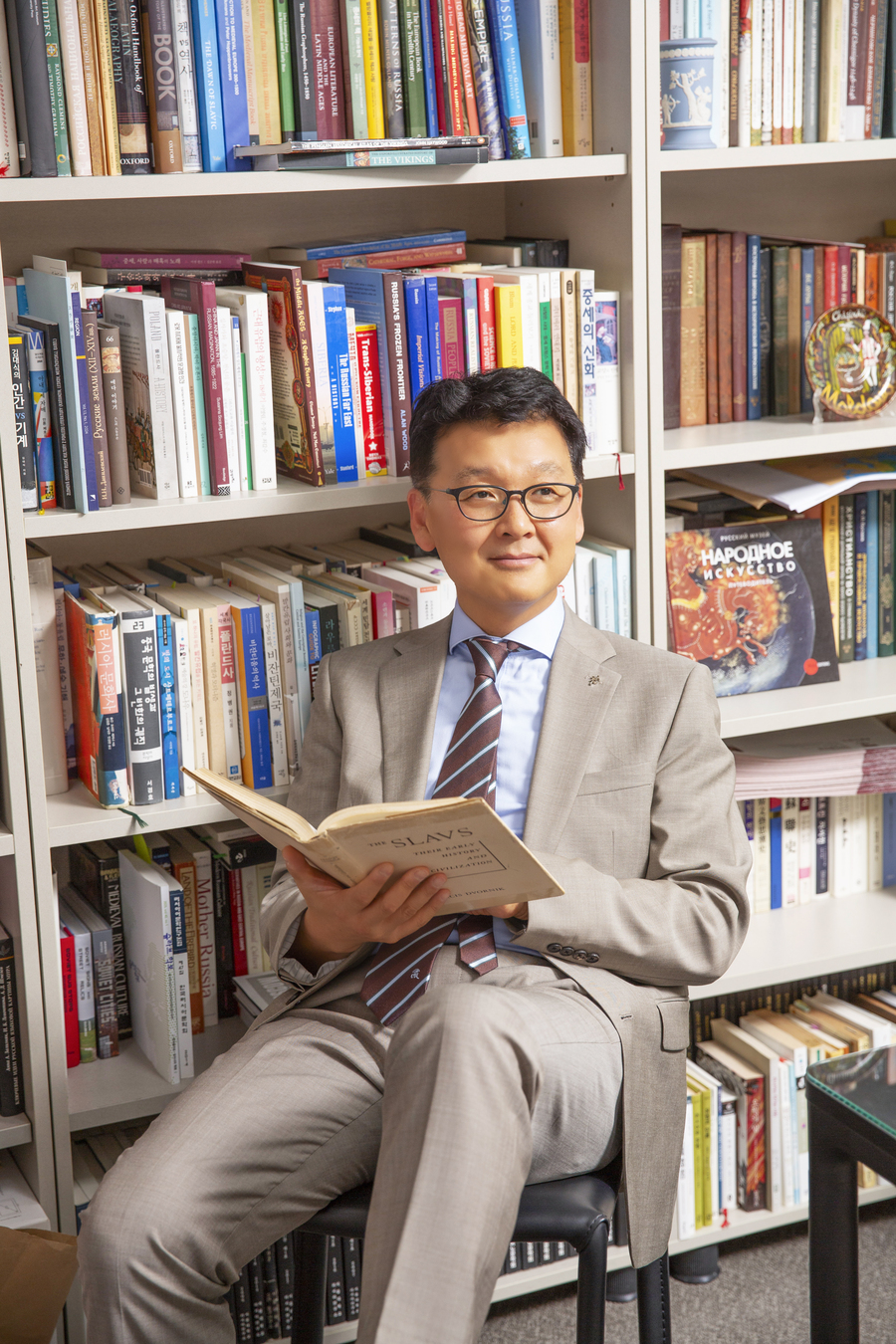
Professor Choi Jung-hyun
Encountering the “unseen Europe” in a general education course
Professor Choi, who had originally focused primarily on core courses for Russian majors, designed and opened this undergraduate general education course in 2022 in response to the surging global interest in the Slavic world. “As the Russia–Ukraine war unfolded, I noticed that students were increasingly seeking to understand the underlying context rather than just the tactical developments of the conflict,” he explains. “It is difficult to truly grasp the present without examining the deep-seated historical, cultural, religious and political currents that have shaped the Slavic world since the Middle Ages.”
The course reveals that the Slavic world is not a peripheral story but is woven into the very fabric of Western history. It traces a line from Jan Hus, the Bohemian reformer who predated Martin Luther, through Nikola Tesla, the visionary Serbian-born engineer, and on to the fatal shots in Sarajevo that triggered World War I in 1914. Professor Choi unpacks the intricacies of international politics and cultural history in approachable terms without stripping away their complexity. In doing so, students discover that the seemingly foreign Slavic world is, in fact, inextricably linked to the world they inhabit now.
Liberal arts as a way to understand others and coexist with them
Professor Choi emphasizes that “the core of this course is not about deciding who is right or wrong, but about cultivating an attitude of understanding toward different cultures.” To this end, he draws on a wide range of media—including video clips, maps, and music—to turn the classroom from a place of passive listening into one of active thinking. “No matter how nutritious a meal may be, you won’t reach for it if it doesn’t look appetizing,” he says. “Lectures are no different. They have to be engaging to truly capture students’ attention.”
SThe students are not passive listeners, either. Throughout the semester, they read texts and watch films related to Slavic culture, submitting short reflection or analytical papers. One student who took the course last year even produced a ten-page essay on a Slavic literary work, prompting Professor Choi to remark, “This could easily be published in an academic journal.” He adds with a smile, “At moments like that, I feel that I am the one learning from my students. The saying ‘teaching and learning grow together’ truly comes to life.”
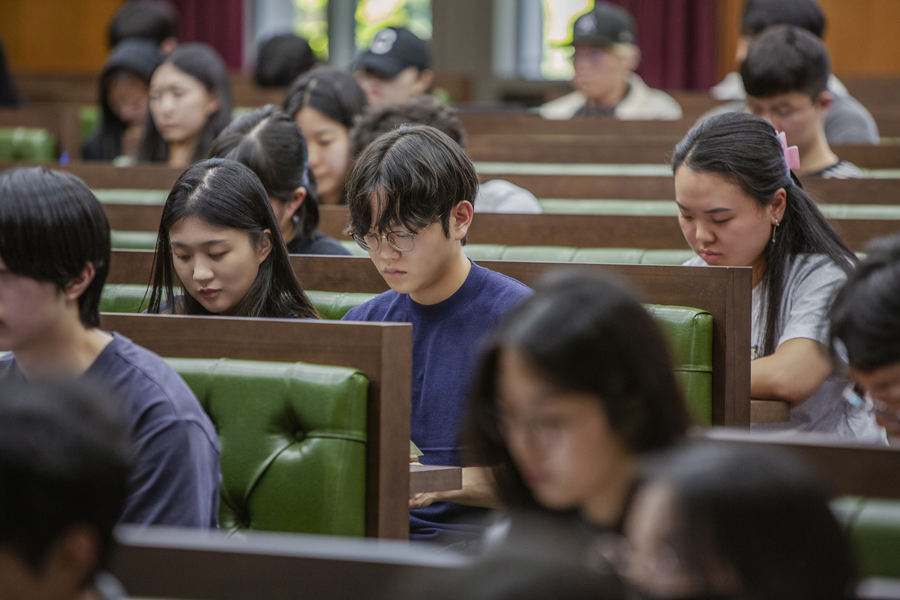
The course attracts a diverse cohort of students from a wide range of majors and year levels. While many initially enroll out of simple curiosity about an unfamiliar world, they finish the semester with a fresh perspective on Europe. Park Jung-uk (Department of Earth and Environmental Sciences, Class of 2020) shares, “In science courses, there is usually a definitive answer. In this class, there isn’t. Having to grapple with the historical context of each era forces you to think much more critically.” Lee Hyun-soo (Department of Medical Science, Class of 2023) says, “Because this is my final semester of pre-medical studies, I applied knowing that opportunities like this would be rare in the future. It helped me move beyond a Eurocentric view centered on France and Germany and to reexamine history through the lens of the Slavic world.”
International student Darya is equally enthusiastic. “The class is so engaging. The professor presents everything like a story, so I look forward to every lecture,” she says. Smiling, she adds, “People often think of the Slavic world as a bit intimidating, but in reality it is a warm and welcoming culture.” Darya goes on to recommend the course “to anyone who wants to gain a new perspective.”
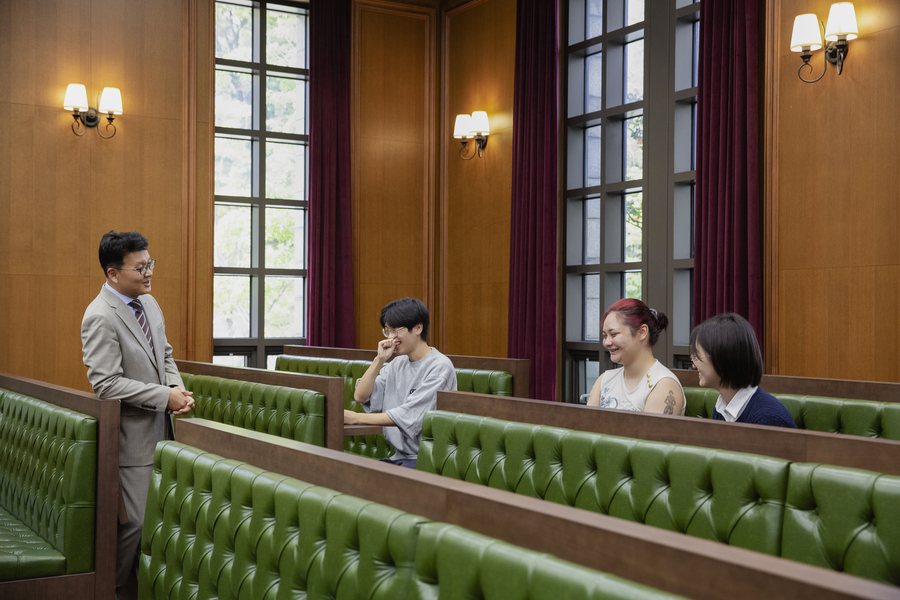
Liberal arts: making the unfamiliar familiar
Park Jung-uk reflects, “I think I’ll be able to approach studying abroad or meeting people from other cultures with a more open mind.” Professor Choi defines the meaning of liberal arts education in these terms: “University is not merely a place to prepare for a career. It is a space where one broadens the scope of one’s thinking by engaging with the unfamiliar. Liberal arts education is the process of seeing the familiar as strange and of making the unfamiliar familiar.”
Understanding the Slavic World precisely embodies this spirit. Rather than focusing on the history of a single nation, it provides a space for cultivating a sensibility for interpreting the world. Challenging yet engaging, unfamiliar yet deeply compelling, the course invites students to understand cultural differences and to connect them with their own lives. This imaginative effort—to understand the “other” and to relate it to one’s own world—is where liberal arts education truly begins.