- writing date 2025.12.12
- author Communication Team
- hits 57
and Documentary Director Choi Jeong-dan (English Language and Literature, Incoming class of 1986)
Slowly Built in a Time-Worn Space

Beyond the wide window, the ridges of Mt. Bukak stretch out with a refreshing calm. In one corner of the living room, a staircase leads up to an old study. Bookshelves are filled to the brim with books and a desk is overrun with them. A fabric-worn sofa, a keyboard with faded keys, a dust-covered monitor, and soft light seeping through faded curtains all speak to the years that have passed. This is the space of Professor Emeritus Kim U-chang.
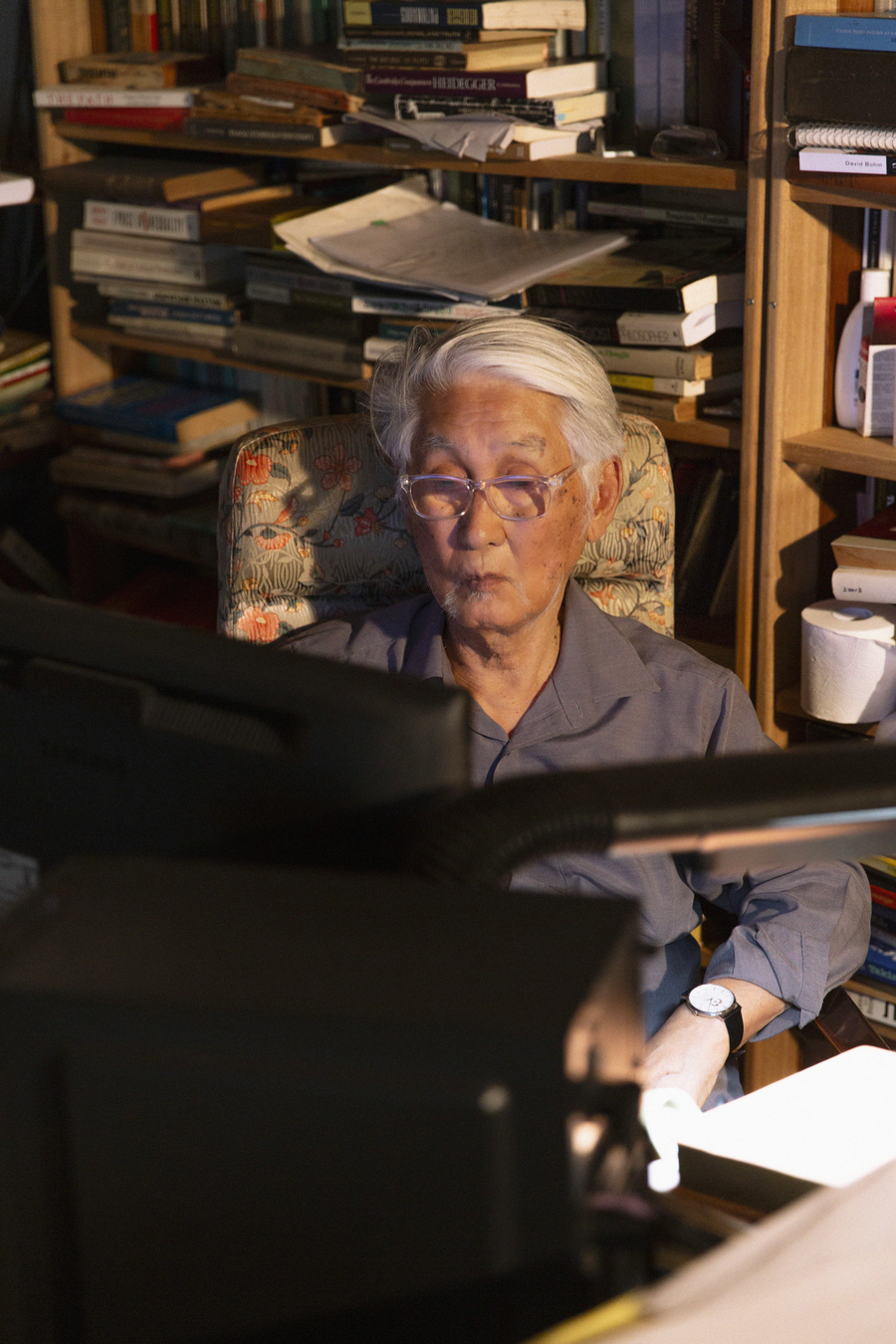
Professor Emeritus Kim U-chang
Passage of time within a space of thought
For more than four decades, Professor Kim’s home has been far more than a place to live. It is a workshop of ideas that bridge humanity and the world, and a reservoir of time in which his philosophy has slowly condensed. Here, he has turned pages, savored sentences, and written his works.
From 1974 to 2003, Professor Kim taught generations of students as a professor in the Department of English Language and Literature at Korea University. Upon retirement, he was appointed Professor Emeritus. Through his continued scholarly activities and writings as a member of the National Academy of Arts and a Distinguished Professor at Ewha Academy for Advanced Studies, he has expanded the horizons of Korean humanities. His selection as a regular member of Italy’s Accademia Ambrosiana in 2018 and the conferral on him of the Geumgwan (Gold Crown) Order of Cultural Merit in 2022 attest to the profound respect he commands both at home and abroad. Many say that his life and scholarship chart the very course that Korean humanities has traveled.
There is someone who has observed Professor Kim’s space—the realm of a great scholar and mentor—for more than 21 years, faithfully capturing it through her camera. She is Choi Jeong-dan, documentary director and former student of Professor Kim. Entering Korea University in the mid-1980s, a period marked by both the fervor of the democratization movement and the disarray of society, Choi first encountered him in his course Introduction to British and American Poetry. On a campus weighed down by despair and anxiety, his class shone like a lone ray of light. The world of poetry and literature she met amid that turmoil offered a rare and precious experience—one that posed a profound question: how should a person exist?
At that time, Professor Kim was more than a lecturer at a podium. He was an intellectual who shouldered the heavy responsibilities of the era. In 1986, representing the Korea University faculty, he drafted and proclaimed a declaration on the nation’s political situation. When students were arrested, he went to the police station himself and pleaded, “Please take good care of our students,” honoring his responsibility to the maximum extent possible. Choi was deeply moved—not only by his integrity as an intellectual, but also by his words, when he said: “A poet is a being who makes us praise even pain.” In them, she found the foundation of the “poet’s soul”—a heart that does not turn a blind eye to the tragedies of reality, yet still experiences gratitude in even the faintest glimmer of hope.
.jpeg "다큐멘터리 <기이한 생각의 바다에서> 스틸컷")
A Scene from the Documentary In the Sea of Strange Thoughts
Diving into a mentor’s “sea of strange thoughts”
In 2004, the year Professor Kim reached retirement age, Choi—having just returned from the United States—attended her mentor’s book launch with a camera in hand. At first, she intended simply to record his lectures. As time went on, however, her lens gradually shifted away from academic documentation and ideological themes, turning instead toward the everyday life of an aging scholar, where thought and life met. In doing so, her camera came to illuminate an intellectual who, in the way he lived, embodied the ethics that a thinking human being ought to uphold.
The documentary In the Sea of Strange Thoughts, directed by Choi, offers a comprehensive portrait of Professor Kim’s inquiries into his era and into humanity. Through the film, Choi highlights his quest-like daily routine, rooted in the pursuit of a “unity of scholarship and life.” On screen, Professor Kim is depicted as a seeker of truth who carries out simple, repeated actions over a long period. Choi explains that she sought to portray how human thought connects with the everyday landscapes of life within the slow and repetitive rhythm of this elderly scholar.
The camera traces the spaces where Professor Kim has lived for years and the quiet blossoms of thought that have taken root within them. Reading, contemplating, tending to plants and pets, writing—these acts flow together like a form of spiritual practice. This is not a portrait of a scholar accumulating knowledge, but a record of a human being exploring existence itself. By capturing her mentor in the intimacy of his personal space, Choi sought to reveal the “human” Kim U-chang, a figure unseen and unknown to the public—never imagining that the process would take so many years.
21-year journey capturing the “unity of scholarship and life”
Literary critic, philosopher, thinker, essayist—even these titles fall short of capturing the full stature of Professor Kim. His wide-ranging intellectual scope, spanning the humanities of East and West as well as politics, art, literature, and the natural sciences, has led many to regard him as an “intellectual of intellectuals” and a “towering figure in Korean humanities.”
“Professor Kim summons thinkers and poets like Merleau-Ponty, Heidegger, Foucault, and Rilke, reinterpreting them through his own thought and extending their ideas in order to open new horizons that Western thinkers left unimagined,” observes Choi. “That originality, I believe, is his strength. I hope people recognize this aspect of his work—though he, of course, seeks no such recognition.” As she says, her documentary strives to preserve the “way of thinking” he practiced, rather than merely the figure of Kim U-chang as a respected name.
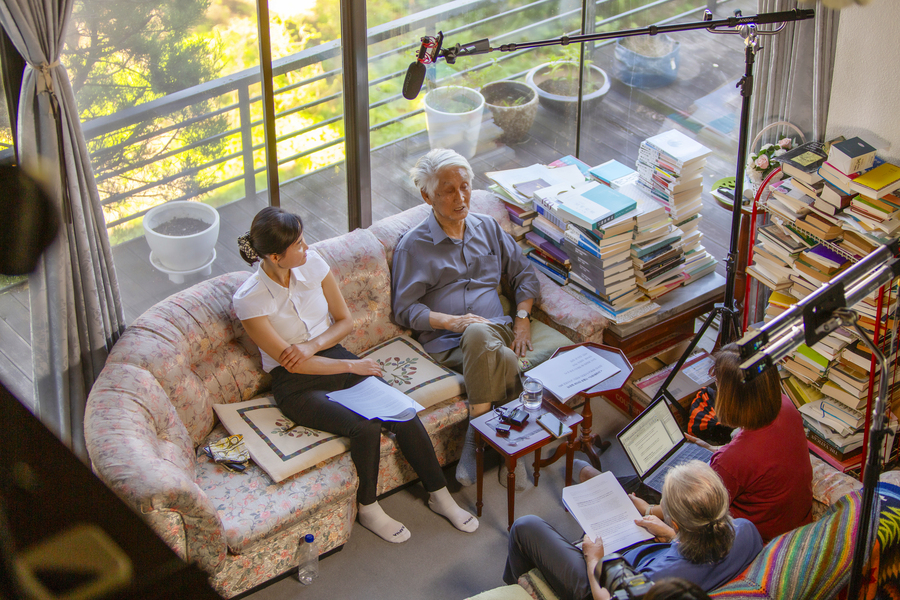
Professor Kim U-chang and Choi Jeong-dan being interviewed in the living room
Over the course of more than two decades it was by no means easy to follow and film the mentor who loves contemplation and silence and spends his days in an intimate, private space. Capturing a figure who is “extremely reluctant to be known publicly” was, at times, arduous. The financial strain only added to the difficulty. She pressed on, paying the production costs out of her own pocket and relying on private support.
After 21 years of work, the documentary In the Sea of Strange Thoughts was completed and officially invited to the Wide Angle Competition at this year’s Busan International Film Festival. It was also selected for the Festival Choice lineup at the Seoul Independent Film Festival, held from November 27 to December 5. The film is scheduled for an official theatrical release next year.

Documentary Director Choi Jeong-dan (Department of English Language and Literature, 1986)
The spirit of intellect passed down to the next generation
Choi hopes that the documentary will serve not merely as a record of Kim U-chang, but as a channel through which the humanistic legacy of an era can be conveyed to future generations. “We now have a substantial archive built over more than 20 years. Going forward, I want to expand this across multiple platforms—broadcasting, YouTube, books. But this is a task far beyond what I can manage alone. It would be significantly encouraging if members of the Korea University community could join me in this meaningful project.”
Professor Kim has become a pivotal axis of thought, forming the foundation on which contemporary Korean humanities stand. In her film, Choi reveals how his ideas have unfolded far beyond his own individual life, reaching into the ethics of scholarship and of the era as a whole.
“There is a passage I am especially fond of from a Distinguished Scholars Lecture Professor Kim delivered in 2005: ‘What makes the world beautiful is not opinions or beliefs, but a gentle heart, kindness, and generosity.’ I believe this statement perfectly illustrates Professor Kim’s attitude toward the world.”
In the Sea of Strange Thoughts, which Choi has brought forth through her long journey, may be understood both as the process of translating an intellectual’s legacy for the next generation and as another mode of contemplation in its own right.