- writing date 2025.12.12
- author Communication Team
- hits 55
explores the science of the global ecosystem resilience

We are in the midst of unprecedented environmental crises such as climate change, rapid biodiversity loss, and the flood of industrial waste and pollutants. Today, in the era of a triple planetary crisis, as defined by the UN, resilience is the most urgent and important required capability for the Earth and the global ecosystem. At the KU OJEong Resilience Institute (Director Lee Woo-kyun, Division of Environmental Science and Ecological Engineering), located in Room 614 of the KU R&D Center, world-class research on the resilience of the global ecosystem is being conducted.
A Donor’s Dream: Becoming a Global Hub for Ecological Resilience
The OJEong Resilience Institute at Korea University (OJERI@KU) was established thanks to a donation from KU alumnus and long-time donor Min Nam-gyu, Chairman of Jakang Co., Ltd. (Department of Agricultural Chemistry, enrolled in 1966). In 2014, Chairman Min pledged to donate a total of 5 billion won (500 million won per year) for ten years in order to cultivate a Nobel Prize winner through research on the protection of the Earth. KU created a matching fund, marking the historic launch of OJERI@KU.
Chairman Min said, “Understanding ecosystem resilience is a core concept of KU’s founding philosophy and a critical issue that can determine our future,” and pledged to provide sufficient support to the institute for its development into a global hub in the field of ecological resilience within the next ten years.
According to Director Lee Woo-kyun, by viewing society, ecology, and landscape as a single integrated system, OJERI@KU is studying structures that can restore environmental balance even in the face of change and shock. Resilience does not refer to a simple restoration of the status quo ante but the ability of cities and ecosystems to form a new order while experiencing changes. Therefore, resilience research focuses on responding to climate change, achieving carbon neutrality, restoring forests and water resources, planning ecological landscape systems and green infrastructure, promoting biodiversity, and establishing environmental policies.
Identifying Earth’s Recovery Mechanisms and Taking Measures Before It’s Too Late
The core concept of thinking on Earth’s resilience stems from the adaptive cycle. All ecosystems go through a cycle comprised of four stages: growth, preservation, disintegration, and reorganization. By applying this cycle to social and ecological systems, researchers at OJERI@KU scientifically identify forest resilience, water cycle and flood management, and urban green infrastructure functions.
Another important strand of research conducted by OJERI@KU is tipping point research. Sometimes a fresh, clean stream suddenly becomes covered with green algae. This happens when a regime shift occurs as a result of a threshold or a tipping point being crossed. This brings about a complete systemic change, and the restoration of the stream is extremely difficult. Using satellite data and AI analysis, OJERI@KU carries out research in order to predict tipping points in the processes of climate change, ecosystem damage, and water quality deterioration, so that the government is able to reflect these data in environmental policies and to take appropriate measures before these tipping points are crossed.
In this period of climate crisis, research on adaptation and transformation, which involves redesigning the processes and systems involved in mitigating shocks within the parameters of existing structures, include forest management that can flexibly respond to climate disasters, the SDGs-WFE nexus strategy that considers the optimal balance between the requirements for water, food, and energy, and the circular economy of waste. By combining the two approaches of adaptation and transformation, the institute designs resilient structures in which society, ecology, and landscape adapt and evolve autonomously.
The science of resilience concerns the process of creating balance in the midst of changes, which goes beyond the ability to simply endure crisis. Based on this principle, OJERI@KU is developing a sustainable model of the future in which environmental science and policy are organically linked.
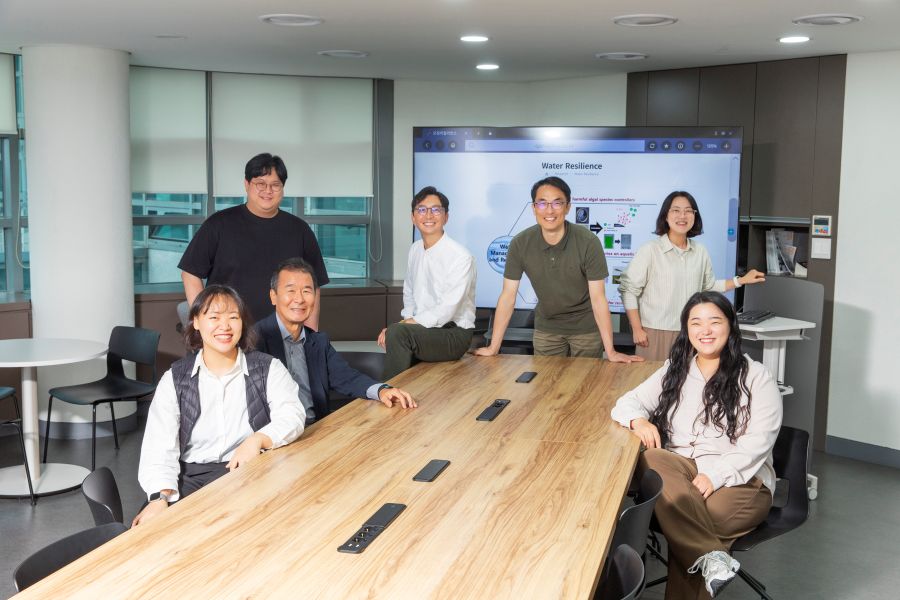
OJERI@KU researchers
The convergence of knowledge that breaks down boundaries: OJERI@KU’s research ecosystem
Director Lee Woo-kyun said, “The greatest asset of our institute is its people and its cooperative ecosystem.” Global environmental issues are huge challenges that cannot be resolved solely with the expertise of a single field. At OJERI@KU, experts from various academic backgrounds, such as environmental science, ecology, and environmental planning, work in five core research teams which break down knowledge boundaries and create dynamic synergies.
The five research teams include the sustainable waste management team, water resilience team, climate change resilience team, ecosystem sustainability team, and SDGs-WFE nexus team. The sustainable waste management team views waste as a resource rather than a source of pollution, and studies technologies and policies that can help build a circular economy; the water resilience team attempts to resolve water issues by seeking ways to control harmful algal blooms and to restore the natural healing power of stream ecosystems; the climate change resilience team assesses the carbon cycle of greenhouse gas absorbers on the Korean Peninsula and suggests sustainable management measures which are based on improving the adaptive capacity to prevent climate disasters; the ecosystem sustainability team studies systems and policies that can enhance the sustainability of ecosystems by developing quantitative and temporal methods of evaluating their health; and the SDGs-WFE nexus team comprehensively analyzes water, food, and energy ecosystems in order to identify strategies to minimize the side effects of problem-solving, and to comprehensively achieve the UN’s sustainable development goals (SDGs).
Deputy Director of OJERI@KU Jeon Jin-hyung (Professor, Division of Environmental Science and Ecological Engineering), explained the collaboration between these research teams, saying, “None of these teams is an independent island. We have an organic collaborative system. For example, to resolve the problem of non-point pollution sources where pollutants discharged from factories leak into streams along with rainwater, our research teams closely cooperate by analyzing water quality (water resilience team), predicting changes in rainfall patterns (climate change resilience team), and assessing biodiversity impacts (ecosystem sustainability team). Then, the SDGs-WFE nexus team combines all these elements and derives the optimal policy measures.”
Leading the Mid-Latitude Region Network and Standing at the Center of Global Climate Action
Because global environmental issues are borderless and the journey to find solutions must also transcend national borders, OJERI@KU has established a joint research network with leading global universities and research institutions, including Standford University, the University of California, Berkeley, and the Stockholm Resilience Centre, and is at the forefront international debates focused on resolving current climate issues. The Mil-Latitude Region Network (MLRN) is the core platform for this conversation.
The mid-latitude region, 30-60°N, is home to more than half of the world’s population, but is vulnerable to climate change, which results in chronic rainfall shortages, water and food system stresses, and desertification. In a situation in which the interests of multiple countries are intertwined, OJERI@KU took the lead in the establishment of MLRN in 2016, thereby launching a forum for “science diplomacy” in order for scientists and policymakers to collaborate across borders.
One of its achievements was the 2025 MLRN Annual International Conference, which was held in Ulaanbaatar, Mongolia in August. Under the theme of “A Sustainable Future: Framework and Governance for Achieving Carbon Neutrality,” the conference was held in collaboration with top organizations from several countries, including the Office of the President of Mongolia, the Royal Family of Bhutan, and the Green Climate Fund (GCF), the world’s largest climate fund. The key concept was “the Third Pole,” Asia’s water reservoir which covers an area including the Himalayan highlands, and provides water to 2 billion people. However, recent glacial melting poses a serious threat to this unique ecosystem and the nomadic culture of its inhabitants that have existed for thousands of years.
To resolve this issue, researchers proposed a carbon neutral village model that would develop climate resilience at the local level as a core agenda, and discussed nature-based resolutions in conjunction with the Billion Tree Planting Campaign of the Mongolian Government. In addition, OJERI@KU confirmed its role and mission as a key intermediary that links science, policy, and finance by working on immediately applicable technologies and policies, such as the establishment of an early warning system for glacier collapse.
11 Years After Launch, a Key Hub for Restoring Ecosystems
OJERI@KU has had many remarkable achievements during its ten-year history. In 2021, it was selected as a key autonomous research institute by the National Research Foundation of Korea (NRF) and is receiving nine years of stable research financial support totaling 12 billion won. This constitutes official recognition of OJERI@KU as a nationally accredited research hub in the field of fundamental science, and the research done at OJERI@KU is expected to become the cornerstone of all climate predictions and the basis for effective environmental policies in Korea.
Moreover, as forest fires have recently grown in scale to become national disasters, OJERI@KU is developing and operating an early warning system for forest fires and landslides in order to keep the public safe.
Research Professor Park Hoon says, “The massive forest fires in March that damaged 104,000 hectares of land emitted approximately 7.64 million tons of carbon dioxide (1% of the country’s annual emissions and approximately 20% of the forest’s annual absorption), sending a warning to the national and local governments regarding the price to pay in the absence of the achievement of carbon neutrality. Since February 2023, we have been providing a public service through our research center website that evaluates the daily risk of forest fires and landslides across the nation through research that scientifically identifies the risk factors involved. This is a great example of science that actively impacts our lives, providing essential information for fire departments to deploy resources in advance and to warn the public.”
In addition, OJERI@KU has introduced the concepts of carbon-neutral villages and a carbon-neutral belt, which transform the environmental value of carbon absorption by forests into economic value and revitalizes local economies through the development of eco-friendly products and the creation of green jobs. This innovative paradigm links climate action with solving the national problem of depopulation outside Seoul. It offers an integrated approach to simultaneously addressing environmental, social, and economic issues by converting the burden of unused land caused by regional depopulation into a key resource for the achievement of carbon neutrality.
OJERI@KU also engages in social integration activities in contributing to resource circulation on campus at Korea University by developing technology that can recover resources from waste plastic and by establishing the Living Lab. It thereby contributes to recycling efforts on campus and aids in the evaluation of community resilience and in the development of alternate policies.
The Journey of Restoring the Global Ecosystem
Begins at the Foundation of Our Lives
The principles of circulation, sustainability, and resilience that OJERI@KU pursues entail lifestyle practices that everyone can and should partake in. Finally, when asked, “What should we do to make the Earth more resilient?” the researchers made the following earnest requests:
1 First, Be a Leader in the Circular Campus.
Please adopt with us the mindset of, “There is no trash, there are only resources.” Small lifestyle changes, such as consciously using fewer disposable products, engaging in meticulous recycling, and considering the entire life cycle of products before buying them, combine to become the basis for a circular economy.
2 Second, Become a Partner in Achieving Campus Carbon Neutrality.
The success of Korea University’s carbon neutrality plan is now in the hands of the KU family. Please conserve energy in labs and dormitories, walk or bike when traveling short distances, and support the university’s investments in green infrastructure.
3 Third, Knowledge is the Most Powerful Tool for Change. Continuously Learn, Participate, and Cultivate Ecological Awareness.
Take liberal arts courses about the environment, attend public lectures held by our researchers, and engage in intense debates with your peers in order to bring sustainability to the forefront of everyone’s thinking.