- writing date 2025.08.25
- author Communication Team
- hits 64
Professor Seo Eun-Suk (Department of Physics, Incoming Class of 1980)

From a young age, Seo showed exceptional interest and talent in science. Despite her parents’ hopes that their bright, high-achieving daughter would become a lawyer, she persuaded them to let her study physics, explaining, “I want to do what I love, so that even when life gets tough, I won’t have regrets.” Captivated by the elegance of explaining natural phenomena through a few fundamental principles and laws, she set her sights on becoming a researcher during her undergraduate years. After earning her master’s degree from Korea University in 1986, she went to the United States for her doctorate at Louisiana State University. “The U.S. was the leader in physics at the time, and since I had been offered a full scholarship, there was no reason to hesitate,” she recalls.
“When I first arrived alone in a foreign country, I wondered, ‘Will I really be able to do this?’ My master’s advisor had suggested that I connect with a professor in the U.S., and just knowing I had someone to meet gave me comfort. When we met, he asked if I’d like to do my doctoral research at NASA. I’d seen the Apollo moon landing on TV, so the idea of working at NASA, the very organization that made it happen, was thrilling.”
Opportunities like this were unimaginable back in Korea, but by gathering up her courage she accepted the challenge. She began her research at NASA’s Goddard Space Flight Center in Maryland, a leading hub for space science, marking the start of her journey toward becoming a world-class astrophysicist.
First Korean Scientist to Receive the U.S. Presidential Award
Seo’s research focuses on cosmic rays, the high-energy particles from outer space that bombard Earth. When these particles collide with atoms in the atmosphere, they fragment, producing secondary particles with lower energies. Particle physicists analyze these fragments to estimate the original energy levels, a method known as “ground-based observation.”
“To improve accuracy, it’s better to measure cosmic rays before they hit the atmosphere. Ground-based detectors can cover several square kilometers but are too large to launch into space. So I designed a detector that works on the same principle but is small enough to operate in space. Now, we can directly measure the composition and energy of cosmic rays from space.”
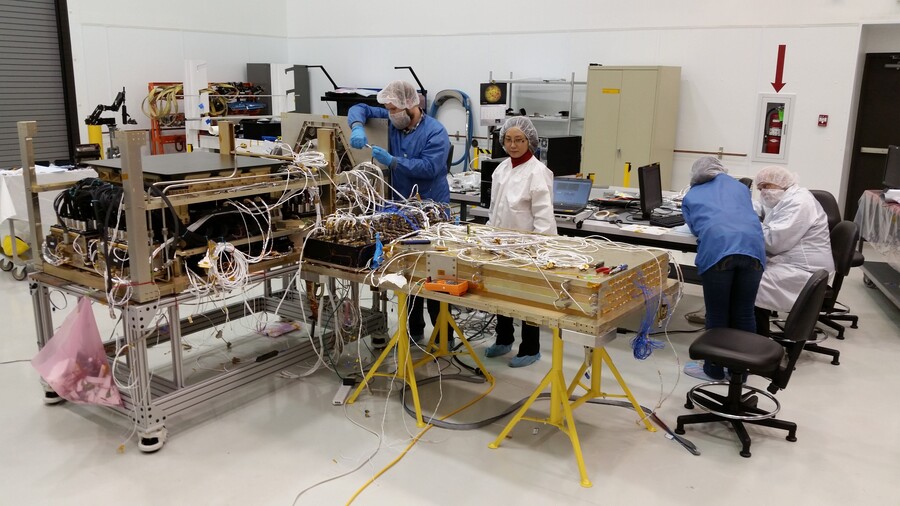
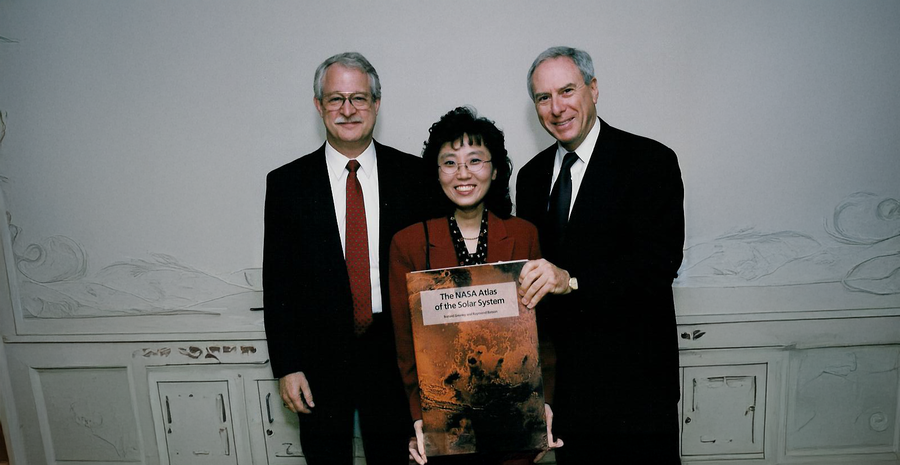
Her idea, developed in her second year as a postdoctoral researcher, led to the creation of such detectors, an innovation that caused excitement in the cosmic ray physics community. In recognition, she received the U.S. Presidential Early Career Award for Scientists and Engineers (PECASE) in 1997, becoming the first Korean scientist to earn this highest honor for young researchers in America.
In 2004, Seo launched the Cosmic Ray Energetics and Mass (CREAM) project with NASA, using balloon-borne detectors over Antarctica to measure cosmic rays. The international collaboration involves over 100 scientists from the U.S., Korea, Italy, France, and Mexico. Today, the upgraded ISS-CREAM project operates aboard the International Space Station, enabling longer observation times and the measurement of even higher-energy particles.
Gratitude to Her Alma Mater for Teaching Leadership and Teamwork
Seo’s research seeks to answer fundamental questions such as What generates such immense energies, and how do they shape our universe? Conducting science in space is both a technical and human challenge.
Asked about her most difficult moment, she replied without hesitation: “When I first took charge of the CREAM project.” Leading a multinational team of specialists who were working toward a single goal was harder than any scientific problem, she said, but her leadership and teamwork skills, honed during her student days at Korea University, were what made it possible. An active member of the university’s photography club, she learned the value of collective work: “I enjoyed taking and developing photos, but I learned even more about how groups work. A team functions best when everyone understands and fulfills their role, and I absorbed teamwork naturally through strong bonds with my seniors and juniors. I later realized how precious that was.”
“I will always be grateful to my alma mater for shaping who I am today. I hope many outstanding graduates will go on to lead in their fields in a new era. To my juniors, I say: Don’t be swayed by outside voices, do what you truly want to do. No matter which path you choose, challenges will arise, but if you love what you do, you’ll have the strength to overcome them. That’s my experience, and it’s the message I wanted to share today.”
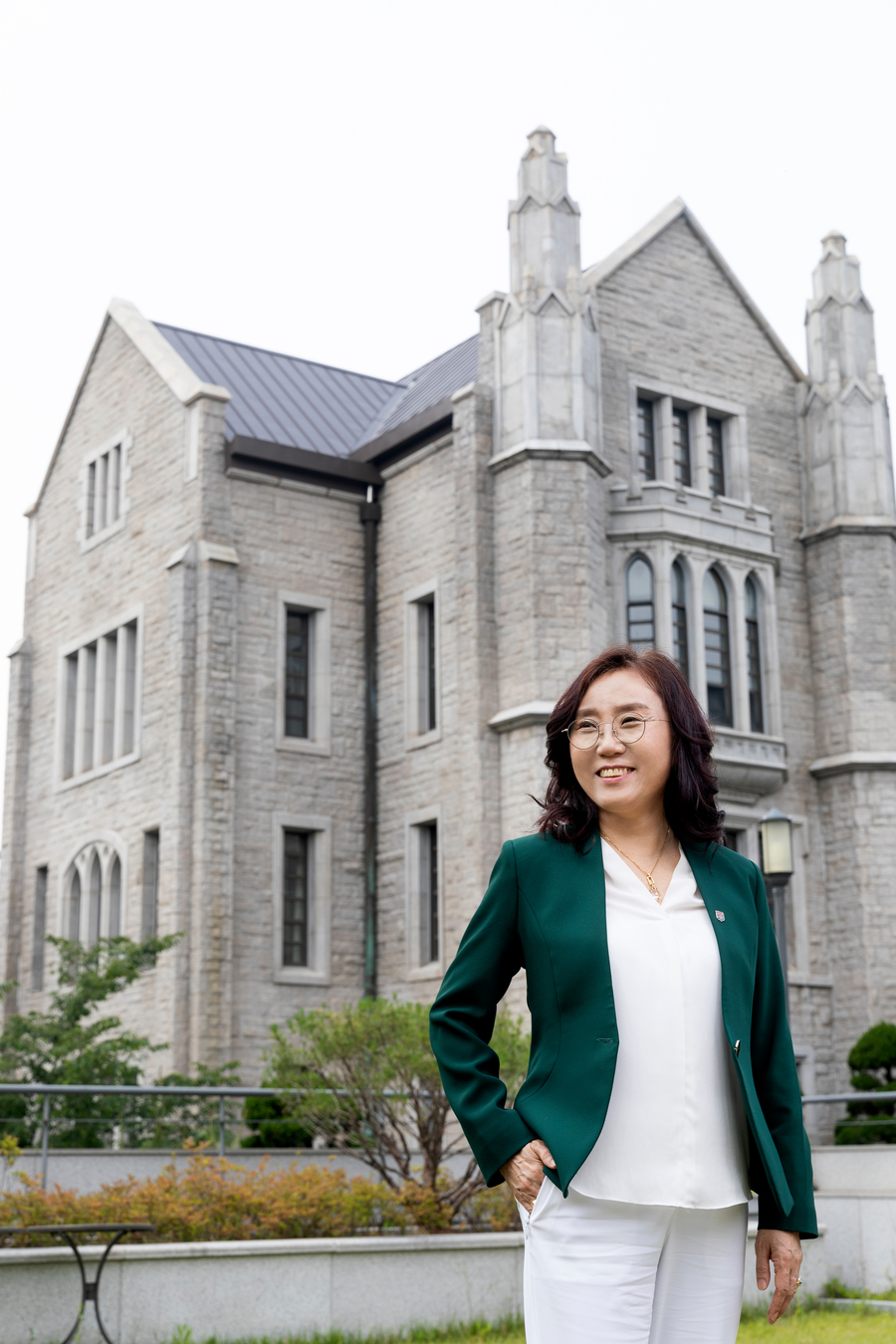
Professor Seo Eun-Suk
Professor Seo earned her B.S. and M.S. in Physics from Korea University and her Ph.D. in Physics from Louisiana State University. She is a tenured professor in the Department of Physics at the University of Maryland and has received numerous prestigious awards, including the 1997 U.S. Presidential Early Career Award for Scientists and Engineers, becoming the first Korean to do so. She is recognized worldwide as a leading authority in astrophysics.