- writing date 2025.05.30
- author Communication Team
- hits 124

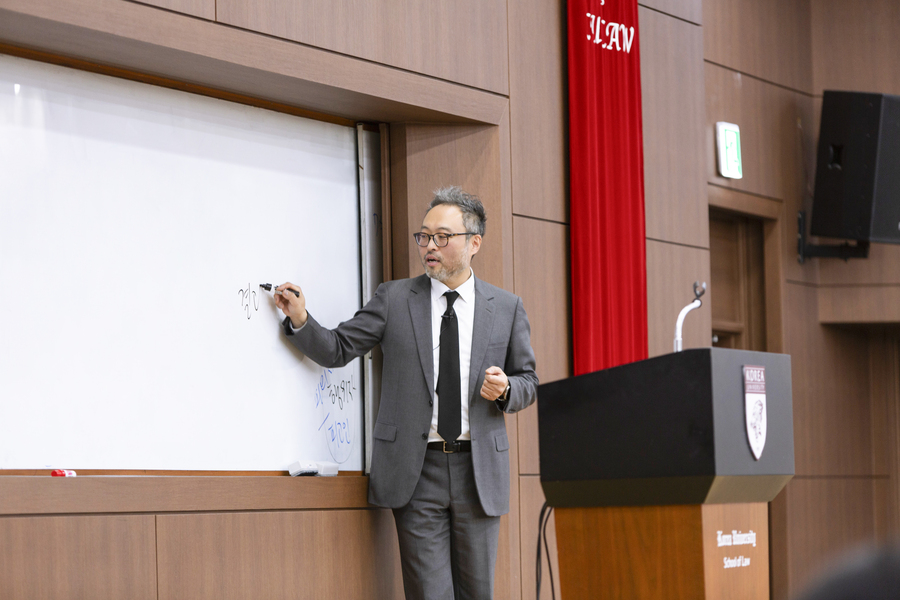
A teaching assistant is busy replacing a broken microphone in a lecture hall at Korea University's School of Law Building. The professor stands at the lectern and begins the class as if nothing has happened, and 400 students listen quietly. There are even several students who have to stand because there are no seats left. There is something about this lecture that makes everyone prick up their ears.

Professor Hong Young-gi's class is so popular that it is difficult to register for it.
With its intriguing title, “Crime and Society,” this course is not a simple introduction to law. It raises questions about the gap between the principles of law and reality. Why are some criminal cases resolved quickly, while others drag on for years? What criteria does the state use to judge and punish crimes? This course is an opportunity to explore these questions together.
The lecture hall is always packed. Students must compete fiercely to secure a spot when registration opens. Seo Yoo-jung, one of the students, said, “I took this class because I wanted to compete,” adding, “The professor explains criminal policy concepts and crime research methods using real-life examples, which makes it interesting.” Ha Yeon-bi, an international student from China, said, “This class is known among the international students as being difficult to get into but really interesting.”
Role-playing often takes place during class. When discussing situations involving legal issues, the professor explains both sides of the argument as if he were an actor in a play. “The professor's tone is amusing, but the real point is that it makes you think even after class is over. My friends and I often discuss what we learned in class, asking each other, ‘What do you think about that?’” said student Oh Seung-soo.

“Real Class” that Broadens Your Perspective
What makes this class unique is that Professor Hong does not encourage students to take notes on their laptops. “My class is not about rote memorization, but about thinking.” Although exams are administered using OMR cards, you cannot answer the questions just by reading the textbook. The discussions, case studies, and questions raised by students during class become the core of the exam questions.
None of the students attending the lecture are law majors. Nevertheless, the students are gradually developing curiosity and interest in law as the lectures progress. Student Jeong Jae-hoon said, “Although I may not encounter many situations involving law in my future life, there are definitely things I need to know. I look forward to the remaining lectures because the professor explains the material in an easy-to-understand manner.”
“Crime and Society” has already won the Seoktap Lecture Award, which is given to outstanding lectures on campus, several times. Many students call this class a great lecture, not just because the professor explains the law well. His lectures deal with criminal law, yet they focus on reality rather than systems, and while pointing out legal norms, they also encourage students to reflect on the human concerns underlying those norms. At a time when people are unsure about how to live their lives, this is a rare class that seriously addresses that very question.
From Questions About the Law to Answers About Life
“If you are a student at Korea University, I hope you are someone who extends a helping hand before tapping on a calculator, someone who does not shy away from doing what needs to be done even if it is inconvenient. That is what I think the true spirit of Korea University is.”
At one point during his undergraduate years, Professor Hong said that he felt that law was not right for him. After auditing other classes and reading books outside his major to consider his direction, he encountered law again in graduate school and came to see it as the “language of society.” This experience, which made him realize that law could be viewed from a fresh perspective, became the starting point for this class.
Although this class was originally intended for law school students, when it was added as a general education course, he began to seriously consider how to explain the specialized content to students in an easy-to-understand manner.
He has some advice he wants to share with his students. “Gain as much experience as you can while you are young. Rather than saving money, try new things like traveling, dating, going to concerts or exhibitions, so that you can figure out what you want in life and make choices accordingly.”
This lecture guides students into the world of law and ultimately helps them gain insight into the direction of their lives. This is why the course leaves a lasting impression on students. Some students who took the course developed an interest in law and ended up attending law school, while many others said it made them think for the first time about how they wanted to live their lives. Eccentric yet sharp, seemingly relaxed yet meticulously structured—that's exactly what the “Crime and Society” course is like.